Claudio Abbado conducts Beethoven and Mendelssohn
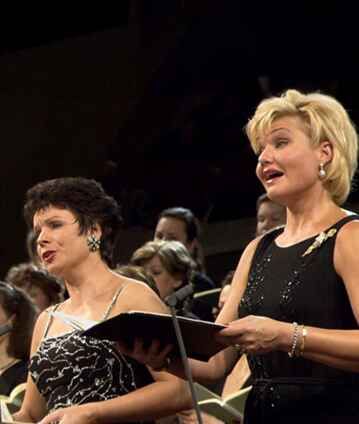
Claudio Abbado conducts works here that captivate with powerful choral singing and unusual forms: Beethoven’s Choral Fantasy with Maurizio Pollini at the piano, followed by Mendelssohn’s Second Symphony known as Lobgesang. Although both works are widely known, they are rarely performed together.
Beethoven’s Choral Fantasy is unique in its combination of human voice, piano and orchestra. The extended piano introduction is probably an impression of Beethoven’s own improvisation style with which he charmed Viennese high society as a young man. The singers make their appearance only at the end of the piece. The choral finale may seem a little reminiscent of Beethoven’s Ninth Symphony, but without achieving or even aspiring to achieve its resoluteness. This is not about the utopia of a better world but a hymn to music and song.
It is also almost impossible to listen to Mendelssohn’s Second Symphony without thinking about Beethoven’s final symphony. At that time it was fundamentally regarded as sacrilege to copy Beethoven’s merging of voice and orchestra in a symphony, and Mendelssohn was the first composer who dared to include a vocal conclusion following the Ninth. It begins with a four-part instrumental movement that is almost a symphony in miniature. The cantata which follows, with its interchange of the dramatic and of celestial beauty, vividly conveys the Romantic era’s view of God: the mighty ruler who is also a comfort to mankind.
© 2002 EuroArts Music International
Artists
Our recommendations
- Claudio Abbado, Maurizio Pollini and Anna Prohaska
- Claudio Abbado conducts works with a maritime theme at the 1998 Europakonzert from Stockholm
- Christian Thielemann and Maurizio Pollini with Mozart’s Piano Concerto No. 21
- Claudio Abbado conducts Brahms and Ravel at the 1996 New Year’s Eve Concert
- Chopin’s Piano Concerto No. 1 with Maurizio Pollini and Christian Thielemann
- Claudio Abbado conducts Mozart’s Requiem at Memorial Concert for Herbert von Karajan