Pietro Mascagni
Compositeur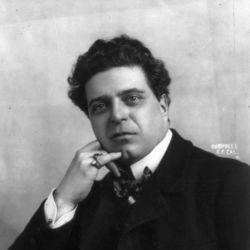
Pietro Mascagni n’avait que 25 ans lorsqu’il connut un succès extraordinaire : son opéra en un acte Cavalleria rusticana, non content de triompher lors de sa création en mai 1890 au Teatro Costanzi de Rome, lança un nouveau courant musical : le vérisme (d’après l’italien vero = vrai), qui met en scène la vie humble des paysans et pêcheurs afin de dénoncer les injustices sociales. Ce drame musical émouvant battit bientôt tous les records d’affluence et Mascagni – qui composa par la suite plusieurs opéras dont très peu, tel L’amico Fritz, figurent encore aujourd’hui à l’affiche – allait demeurer l’homme d’un seul succès.
Né en 1863 à Livourne sur le littoral toscan, Pietro Mascagni étudie à partir de 1876 à l’Institut musical de sa ville natale auprès d’Alfredo Soffredini, qui l’encourage à devenir compositeur contre la volonté de ses parents. Après le succès de sa cantate In filanda, il entre au Conservatoire de Milan où il suit les cours d’Amilcare Ponchielli et Michele Saladino. Sans attendre d’obtenir son diplôme, Mascagni interrompt ses études à l’âge de 20 ans pour gagner sa vie : après un engagement de contrebassiste au Teatro Dal Verme de Milan, il devient chef d’orchestre d’une troupe d’opérette avec laquelle il parcourt l’Italie. En 1887, il prend le poste de maestro di suono e canto municipal à Cerignola. Un an plus tard, Mascagni lit par hasard une annonce de l’éditeur milanais Edoardo Sonzogno, qui vient de lancer un concours de composition d’opéras en un acte. Mascagni range dans un tiroir la partition de son premier opéra, Guglielmo Ratcliff, auquel il est en train de travailler, et compose Cavalleria rusticana pour le concours. Parmi les 73 contributions soumises, le jury vote pour celle du novice, qui devient du jour au lendemain l’un des compositeurs les plus célèbres d’Italie. Après le triomphe de la création, Mascagni compose de nouvelles œuvres pour les plus grands théâtres et entame une carrière de chef d’orchestre qui le mène à Vienne, Paris et Londres, puis aux États-Unis et en Amérique du Sud. Il parvient à gagner les faveurs du régime fasciste et prend la direction du Teatro alla Scala en 1944 après le départ d’Arturo Toscanini. Néanmoins, aucune de ses œuvres scéniques – son ultime opéra, Nerone, date de 1935 – ne connaît un succès comparable à celui de Cavalleria rusticana.