卢奇亚诺·贝利奥
作曲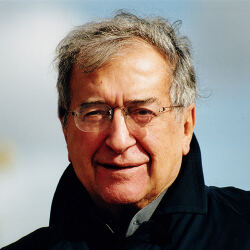
In the middle of the 20th century, Luciano Berio was Italy’s leading living composer and a key figure in the post-war avant-garde. He played a decisive role in the musical developments of those years, particularly in the exploration of electronic music. At the same time, he was a pioneer who never lost sight of tradition – as demonstrated by his numerous arrangements and orchestrations of works by Purcell, de Falla, Verdi, Mahler and Puccini, as well as his connections to folk music, which he declared to be “emotional in nature”.
Berio, who received his first music lessons from his father and grandfather (all his ancestors back to the 18th century were musicians), studied composition at the conservatory in Milan under Giorgio Federico Ghedini. He then went on to study under Luigi Dallapiccola, who regularly taught courses at Tanglewood at the time. Together with Bruno Maderna, Berio founded the Studio di Fonologia Musicale, where works such as Mutazioni, Perspectives and Thema (Omaggio a Joyce) were created. In Darmstadt, he was influenced by Henri Pousseur, who, alongside Stockhausen, Boulez, Nono and others, was one of the leading figures in New Music. In 1963, Berio moved to the USA, where his teaching positions included posts at Harvard University and the Juilliard School. At the same time, he explored the world of electro-acoustic music in the studios of Columbia University and the Bell Telephone Company. Returning to Europe in 1972, Berio worked not only as a composer but also as a conductor, festival director, artistic director of the Accademia Filarmonica Roma and as a member of the board of directors of IRCAM (Institut de recherche et coordination acoustique/musique). His Sinfonia, dedicated to Leonard Bernstein and the New York Philharmonic Orchestra, was a great success. In it, he explores the work of Gustav Mahler in depth, representing the entire history of music over the past 200 years. This was followed by further works in which Berio explicitly took up threads from music history: these included Rendering, a commentary on sketches for Schubert’s Symphony No. 10, four orchestral movements based on Mozart’s Singspiel fragment Zaide, and a reworking of the finale of Puccini’s opera Turandot.