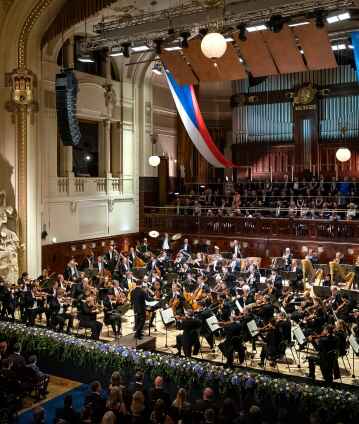
Kirill Petrenko conducts Smetana’s “Má vlast” at the Prague Spring
The Prague Spring International Music Festival begins every year on 12 May, the anniversary of Bedřich Smetana’s death, with a performance of his Má vlast (My Country). Thanks to a musical language that combines folk elements with the Western European musical tradition, the composer is regarded as the founder of a Czech national style. In 2024, the Berliner Philharmoniker and chief conductor Kirill Petrenko opened the festival with the popular cycle – a musical journey through the landscape, history and mythology of the Czech Republic.
Audiences attending a concert in Prague’s Smetana Hall would do well to look up, where they will find a jewel in the crown of Art Nouveau: a monumental glass dome framed by stucco work adorned with gold leaf and large-scale ceiling frescoes. The Municipal House, which opened in 1912 and houses the hall, was modelled on the Baroque royal court. As one of the first fully electricity-powered buildings in Prague, it combined state-of-the-art technology with architectural elegance. The Prague Spring International Music Festival concerts take place here and in the concert halls of the Rudolfinum on the banks of the Vltava.
Everyone learns about it in music lessons here: The Moldau, named after the longest river in the Czech Republic, is one of the best-known pieces of classical music. Its vivid musical language makes it a prime example of Romantic programme music, and is the second piece in the cycle Má vlast, whose six symphonic poems Bedřich Smetana composed between 1874 and 1879. The astonishing thing is that he himself was unable to hear his own music. In 1874, Smetana, like Beethoven, suffered the tragic fate of losing his hearing: “If my illness is incurable, I wish to be soon released from this painful existence.” The fact that Smetana was able to put such an “inexhaustible wealth of colour” to paper under these circumstances is described by Kirill Petrenko in our Upbeat introduction to the work as “one of the outstanding achievements in the history of music”. Vyšehrad, the first part, recounts the glorious days of the famous castle in an ancient, almost legendary tone and is unmistakably inspired by Wagner’s Valhalla. In The Moldau, two springs make their way – tentatively at first, then with increasing force – and finally merge into a raging torrent. Šárka recounts a legend in which a female warrior takes bloody revenge on the male world, while Z českých luhů a hájů (From Bohemia’s Woods and Fields) is a vivid depiction of nature. In marching rhythms and with sombre fanfares, Tábor recounts the battle for the town of the same name, and the final movement, Blaník, triumphs with a reprise of the Vyšehrad motif. The premiere of the complete work in 1880 was met with rapturous applause, which Smetana – having become completely deaf – was no longer able to hear.
© Česká televize / UNITEL 2024