アーロン・コープランド
作曲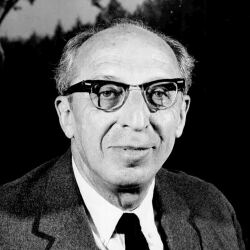
Aaron Copland is regarded as the creator of a distinctive “American” musical idiom – echoes of his music can still be heard today in the soundtracks of countless Hollywood blockbusters. He came to his popular, deliberately simple style after the Great Depression: as a political leftist who was committed to the Popular Front, which was supported by the Communist Party of the USA and the trade union federation CIO, among others.
The son of Russian-Jewish immigrants, Aaron Copland grew up in Brooklyn and from childhood was fascinated by the typical New York blend of synagogue music, klezmer, jazz and ragtime dance bands. After early piano lessons with his older sister, he received instruction from the arch-conservative Rubin Goldmark, who had studied in Vienna under Robert Fuchs and in New York under Antonín Dvořák. In search of greater innovation, Copland went to Paris in 1921, where he was taught by Nadia Boulanger at the Conservatoire américain de Fontainebleau. After returning to the United States, Copland considered the idioms of the so-called Jazz Age to be the most suitable for conveying the pulse of urban America and the special atmosphere of New York City. However, his enthusiasm for jazz waned significantly when the optimistic façade of the Roaring Twenties began to crumble in the run-up to the Great Depression. He moved towards a Modernist style, which earned him the nickname “Brooklyn Stravinsky”. Ultimately, Copland came to the conclusion that modern composers ran the risk of becoming socially marginalised with their complex musical language: “My most recent works, in their separate ways, embody this tendency toward an imposed simplicity. El Salón México is an orchestral work based on Mexican tunes; The Second Hurricane is an opera for school children of high-school age to perform; Music for Radio was written on a commission from the Columbia Broadcasting Company especially for performance on the air; Billy the Kid utilizes simple cowboy songs as melodic material; The City, Of Mice and Men and Our Town are scores for the films. The reception accorded these works in the last two or three years encourages me to believe that the American composer is destined to play a more commanding role in the musical future of his own country.”