Emmanuelle Haïm conducts Handel in Baden-Baden
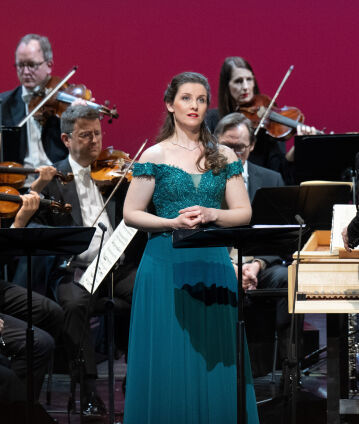
George Frideric Handel’s oratorio Il trionfo del Tempo e del Disinganno explores the question of whether hedonism offers lasting fulfilment. Conducted by Baroque specialist Emmanuelle Haïm, a distinguished cast of stars embodies the allegorical vocal roles of Beauty, Pleasure, Time and Truth. A musical contest plays out between them, full of virtuosic music and operatic drama. The Berliner Philharmoniker presented this emotionally charged work at the Easter Festival in Baden-Baden.
What do George Frideric Handel’s Il trionfo del Tempo e del Disinganno and a traditional German stuffed pasta have in common? Apart from the sensual pleasure they provide, both serve to deceive: as meat was forbidden during Lent, legend has it that this German-style ravioli – also known in this context as a “Herrgottsbscheißerle” (God-cheaters) – was intended to conceal meat within a pasta casing to hide it from God’s eyes. In a similar way, Handel circumvented a papal ban on opera at the time by “packaging” his work as an oratorio. What is particularly ironic is that the librettist of Il trionfo was himself a man of the Church: Cardinal Benedetto Pamphilj made his mark on Rome’s artistic scene around 1700 not only through his own literary and musical compositions, but above all as a generous patron. Handel was one of his favourite composers, as evidenced by their first collaboration: the cantata “Hendel, non può mia musa” (Handel, my muse cannot sing verses worthy of your lyre) is a reverent hymn of praise to “Il Sassone” (the Saxon).
Handel is thought to have set Il trionfo del Tempo e del Disinganno at the librettist’s home in 1707. The plot is quickly told: everything revolves around the question of whether the young Beauty should indulge in the pursuit of pleasure or – urged relentlessly by Time and Truth – should turn her thoughts to something more enduring. She initially succumbs to temptation, but soon realises that beauty fades and pleasure is deceptive. In the end – as the title ultimately suggests – those who warn her triumph, and Beauty, thanks to her new-found insight, enters a convent as a virtuous woman.
While the opera’s clever disguise as an oratorio is unmistakable in Handel’s delicate and dramatically expressive music, the story of the monk who came up with the cunning idea of the “Herrgottsbscheißerle” is much disputed. But one thing is certain: the hearty stuffed pasta would have appealed just as much to the devoted gourmet Handel as Il trionfo del Tempo e del Disinganno did to the audience – then as now.
Berliner Philharmoniker
Emmanuelle Haïm
Julia Lezhneva
Elsa Benoit
Carlo Vistoli
Anicio Zorzi Giustiniani
© 2023 EuroArts Music International
Category
Artists
Our recommendations
- With Gustavo Dudamel in Taiwan
- Joint concert from Israel with the Israel Philharmonic Orchestra and Zubin Mehta
- Kirill Petrenko conducts Schumann, Wagner and Brahms in Taipei
- Simon Rattle conducts “Tosca” in Baden-Baden
- Daniel Barenboim and Plácido Domingo at the 1992 Europakonzert in the Escorial
- Sir Simon Rattle with Rachmaninov and Stravinsky at the Lucerne Festival