Kirill Petrenko conducts Mahler’s Ninth in Amsterdam
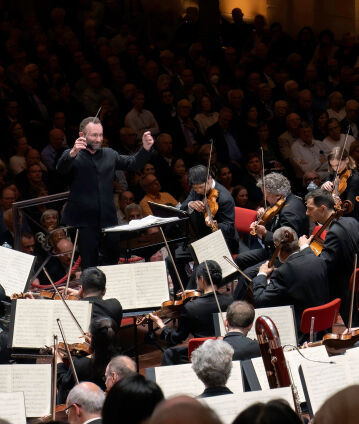
The third edition of the Mahler Festival in Amsterdam, marking its 100th anniversary, was actually due to have taken place in 2020. However, as a result of the pandemic, the festival – which features performances of the complete cycle of Gustav Mahler’s symphonies – had to be postponed for five years. This made the anticipation all the greater for the Berliner Philharmoniker, who, together with chief conductor Kirill Petrenko, had the honour of performing the penultimate concert of the festival with the composer’s monumental and visionary Ninth Symphony.
The Koninklijk Concertgebouw in Amsterdam and the Berliner Philharmoniker are practically the same age: in 1882, the year the orchestra was founded, the decision was taken to build the concert hall in the Dutch capital, and construction began the following year. The view of the semi-circular concert stage in the main auditorium is as majestic as the venue’s name: it is not only home to an imposing organ, there are also two long, striking staircases, covered in red carpet, which lead down from a gallery above the stage to the stage itself – ensuring that all performers make their grand entrance before the audience’s eyes. While the interior design is inspired by the old Leipzig Gewandhaus, acoustically the hall – like the Philharmonie Berlin – ranks among the very best in the world.
Against this backdrop, the Berliner Philharmoniker and Kirill Petrenko travelled to Amsterdam perfectly prepared, having recently performed Mahler’s Ninth Symphony – a work particularly challenging in terms of its tonal balance – “at home”. Unlike with his previous symphonies, the composer did not have the opportunity to make corrections to the score after the world premiere; Mahler died in 1911, a year before the premiere of his Ninth.
In Mahler, the musical world lost one of its great visionaries. Alban Berg described the Ninth Symphony as “the first work of New Music”. Its radical modernity becomes apparent immediately in the first movement, whose chromatically dense harmony confidently breaks free from the tonal framework of late Romanticism and emerges as a defining compositional element. The melodic element recedes into the background, while thematic fragments emerge without the listener being able to follow them for long – Mahler musically symbolises one of the most significant themes that had moved and weighed heavily on him, particularly since the diagnosis of his heart condition: becoming and passing away. A work of new beginnings, then? Certainly, for Mahler unquestionably paved the way for later generations – including, amongst others, the Second Viennese School. At the same time, the Ninth marks an endpoint, or as Willem Mengelberg, the conductor and founder of the Amsterdam Mahler Festival, put it, “Mahler’s soul sings its farewell!”
Berliner Philharmoniker
Kirill Petrenko
© 2025 PolyCast Productions for The Royal Concertgebouw
Category
Artists
Our recommendations
- Kirill Petrenko conducts Schumann, Wagner and Brahms in Taipei
- 2023 Europakonzert from Barcelona with Kirill Petrenko
- 2026 Europakonzert with Kirill Petrenko and Gautier Capuçon from Esterházy Palace
- Kirill Petrenko with Strauss’s “Die Frau ohne Schatten” in Baden-Baden
- Kirill Petrenko conducts Strauss’s “Elektra” at the Easter Festival in Baden-Baden
- Zubin Mehta conducts Mozart, Schumann and Tchaikovsky in Évian