Interview
Gautier Capuçon in conversation with Solène Kermarrec
2026 Europakonzert with Kirill Petrenko and Gautier Capuçon from Esterházy Palace
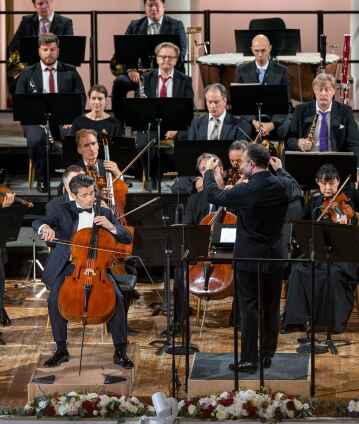
This year, the Berliner Philharmoniker’s Europakonzert with Kirill Petrenko follows in the footsteps of the First Viennese School: Joseph Haydn worked at Esterházy Palace for almost 30 years. After an overture by Haydn, the orchestra will then perform the Second Symphony by his pupil, Ludwig van Beethoven. Pyotr Ilyich Tchaikovsky’s Rococo Variations with cellist Gautier Capuçon offer a more Mozartian take on Classicism – and Igor Stravinsky’s Pulcinella even looks back to the Baroque era.
Esterházy Palace, near Eisenstadt in the Austrian province of Burgenland, has been owned by the Esterházy dynasty since 1649. Princes Paul Anton and Nikolaus I were knowledgeable music lovers, and so they supported the work of Joseph Haydn, who – far removed from Europe’s musical capitals – spent much of his life at their court. As Kapellmeister, he composed some 90 symphonies there, and organised countless performances of these and other works. When he took up his post in 1761, the House of Esterházy was one of the most powerful and wealthiest in the Habsburg monarchy. This status is reflected in the magnificent Baroque hall – initially known as the Great Ballroom, but soon referred to simply as the Haydnsaal (Haydn Hall) – where, beneath the splendid frescoes adorning the ceiling, the high society of the time would regularly gather to attend concerts conducted by the composer. Although the surroundings were provincial and rural, the guests who came and went at Estherházy Palace were cultured and cosmopolitan: German, Hungarian, French and Italian were spoken, and people of Slovak and Croatian origin, as well as Sinti and Roma, were an entirely natural part of society.
In 2026, the castle is the venue for the Berliner Philharmoniker’s Europakonzert, with which the orchestra has, for 35 years now, celebrated not only its founding but also the shared values of a peaceful Europe on 1 May. Haydn’s cheerful overture in D major – a key considered particularly majestic in its day – opens the programme at this venue, which played such an important role in the composer’s life.
In 1927, Romain Rolland described Ludwig van Beethoven as “the shining symbol of European unity and universal humanity”. The Bonn-born composer studied in Vienna for about two years under Haydn after the latter had left Esterházy Palace. Beethoven’s Second Symphony bears the audible influence of his teacher; the playful motifs, for example, reflect a typically Haydnesque wit. However, thanks to a greater dramatic intensity and an urgent, combative character, it also bears Beethoven’s distinctive signature.
Chief conductor Kirill Petrenko also presents the Pulcinella suite, in which Igor Stravinsky paid homage not only to Haydn and the composers of the First Viennese School, but also to Italian Commedia dell’arte. Star cellist Gautier Capuçon, who previously performed with the Berliner Philharmoniker in Austria as part of the 2012 Europakonzert, is the soloist in Pyotr Ilyich Tchaikovsky’s Variations on a Rococo Theme – a delightful fusion of Classical elegance and Romantic virtuosity.
Berliner Philharmoniker
Kirill Petrenko
Gautier Capuçon
© 2026 EuroArts Music International
Related interview
Categories
Artists
Our recommendations
- 2022 Europakonzert from Liepāja with Kirill Petrenko
- 2023 Europakonzert from Barcelona with Kirill Petrenko
- 2021 Europakonzert from Berlin with Kirill Petrenko
- 2020 Europakonzert from the Philharmonie Berlin with Kirill Petrenko
- 2001 Europakonzert from Istanbul with Mariss Jansons and Emmanuel Pahud
- 2005 Europakonzert from Budapest with Simon Rattle and Leonidas Kavakos