Interview
Gabriela Ortiz about “Revolución diamantina”
Gustavo Dudamel conducts Beethoven’s “Eroica”
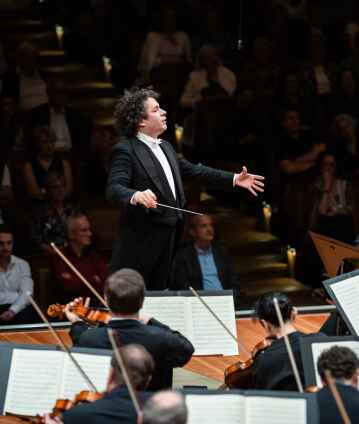
Inspired by the French Revolution, Beethoven pushed the boundaries of the symphony with his combative Eroica: it was longer, bigger and more innovative than anything that had gone before. Gustavo Dudamel pairs it with another work of rebellion: Gabriela Ortiz’s Revolución diamantina thematises the “glitter revolution”, the feminist protest against the ongoing violence against women in Mexico. According to Dudamel, Ortiz’s music is “full of intuitive, primeval rhythms and mysterious, soulful soundscapes”.
Gabriela Ortiz dedicated one of the three Grammy Awards she received in 2025 for her composition Revolución diamantina to “all the women in Mexico and the rest of the world who fight against injustice every day”. The ballet, created in collaboration with Pulitzer Prize-winner Cristina Rivera Garza, takes its name from the wave of feminist protests that swept across Mexico in 2019. In a single year, 3,893 homicides of women were committed there – which equates to eleven women a day and represents a shocking record. The inaction of the authorities – around 95% of such crimes go unpunished in Mexico – also fuelled the outrage. Protesters found a very unique form of expression, throwing glitter at security forces during large-scale nationwide demonstrations. Glitter is highly visible and difficult to clean off; glitter as a symbol of peaceful resistance.
Are we witnessing a feminist revolution? Future generations will interpret the developments of our era in this way, says Alejandro Escuer, one of Mexico’s leading performers of contemporary music. The flautist describes Gabriela Ortiz’s mystical and powerful music as a “sonorous premonition” and a “ritual in motion”. Masterfully orchestrated for an ensemble augmented by numerous Central and South American percussion instruments, this work blends echoes of traditional and indigenous music with contemporary pop culture. Gustavo Dudamel, a close artistic associate of both the composer and the Berliner Philharmoniker, presents the concert version of Revolución diamantina.
Ludwig van Beethoven once said that he sometimes had an image in his mind whilst composing. When he wrote his Third Symphony, perhaps it was the figure of Marianne, the symbol of liberty and the Republic, that guided him. As a young man, the composer had followed the events of the French Revolution with keen interest and admired Napoleon for his fighting spirit. When Bonaparte had himself crowned Emperor in 1804 – effectively betraying the ideals of the Revolution – Beethoven removed the original dedication to him from the Eroica. Despite his disappointment at the fall of his hero, Beethoven steadfastly pursued his own revolutionary path in his Third – as in the symphonies that followed – a path that was to shape the world of music for generations to come.
Berliner Philharmoniker
Gustavo Dudamel
Women of the Rundfunkchor Berlin
© 2026 Berlin Phil Media GmbH
Related interview
Interview
Gustavo Dudamel in conversation with Stefan Dohr
Artists
Our recommendations
- Mahler’s Third with Yannick Nézet-Séguin and Joyce DiDonato
- Gustavo Dudamel conducts Mahler’s Fifth Symphony
- An “American Evening” with Gustavo Dudamel
- Gustavo Dudamel conducts Bernstein and Shostakovich
- Gustavo Dudamel conducts Mahler’s Third Symphony
- Gustavo Dudamel conducts Tchaikovsky and Brahms at the Waldbühne