Simon Rattle conducts Dvořák and Brahms in Lucerne
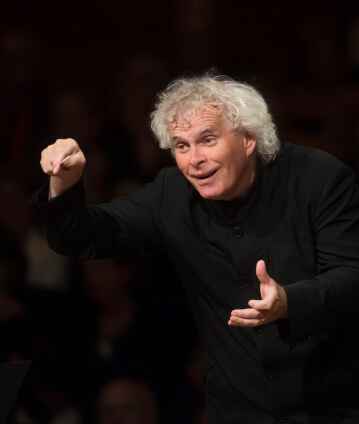
This programme, with which the Berliner Philharmoniker and Sir Simon Rattle made a guest appearance at the 2016 Lucerne Festival, celebrates a creative friendship between two composers: Antonín Dvořák owed his breakthrough in 1878 with the exuberantly lively Slavonic Dances in part to his patron Johannes Brahms. The North German composer had triumphed a year earlier with his Second Symphony, a skilfully constructed masterpiece of great depth and dramatic tension.
“Dvořák has written all sorts of things: operas (Bohemian ones), symphonies, quartets, piano pieces. In any case, he is a very talented man. And poor, too! I would ask you to bear that in mind!”, wrote Johannes Brahms to his publisher in 1877. Seven years earlier, Fritz Simrock had taken over the publishing house founded by his grandfather and continued to run it successfully – his Berlin villa was a regular haunt for greats such as Clara Schumann and Joseph Joachim. Antonín Dvořák, the son of an innkeeper, had been composing for years without hope of his works being performed, and earned his living as a piano teacher and violist at the theatre in Prague. Simrock showed an interest in the work of the still largely unknown Czech composer: he commissioned and published the Slavonic Dances for piano four hands, which were intended to follow in the stylistic footsteps of Brahms’s popular Hungarian Dances. Simrock did not, however, comply with the request for a generous fee – even though Dvořák’s dances proved to be a big hit: in the climate of an emerging educated middle class, where playing the piano was considered good form, the lively Slavonic Dances captured the spirit of the times. Unlike Brahms in his Hungarian Dances, Dvořák did not use actual quotations from folk music – he invented his own melodies with a folk-like quality. Shortly afterwards, he produced an orchestral version, for which he finally, at the age of 37, received long-awaited international recognition. He remained deeply grateful to his mentor Brahms and maintained a close friendship with him until the latter’s death in 1897.
Whilst Dvořák’s musical language has an intuitive and – in the best sense of the word – naïve quality to it, Brahms took a more intellectual approach to his works. He described his Second Symphony as a “charming monster”: cheerfulness and seriousness lie very close together here – light and darkness are, you could say, interwoven. Clouds quickly gather over the pastoral idyll of the first movement; the solemn adagio ends with ominous timpani beats, before the carefree ländler theme of the third movement flows into the jubilant finale. The self-styled melancholic rarely appeared so cheerful – he had “never written anything so sad, so minor-key”, he wrote wryly to Fritz Simrock. Following the resounding success of his First Symphony, Brahms was assured of a handsome fee.
Berliner Philharmoniker
Sir Simon Rattle
© 2016 Accentus Music
Category
Artists
Our recommendations
- Simon Rattle conducts “Manon Lescaut” at the Easter Festival in Baden-Baden
- Sir Simon Rattle with Sibelius, Ravel and Debussy at the Lucerne Festival
- The Berliner Philharmoniker, Simon Rattle and Karita Mattila at the “Proms”
- Simon Rattle conducts the 2016 Europakonzert in Røros
- Sir Simon Rattle with Rachmaninov and Stravinsky at the Lucerne Festival
- 1993 Europakonzert from London with Bernard Haitink and Frank Peter Zimmermann