Interview
Kirill Petrenko in conversation with Philipp Bohnen
2026 season opening concert: Kirill Petrenko conducts Elgar and Tchaikovsky
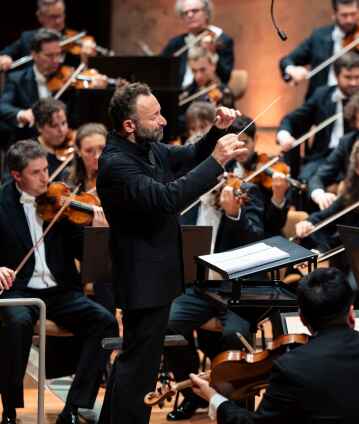
Kirill Petrenko presented two sumptuous works containing hidden messages to mark the opening of the season. In his Enigma Variations, Edward Elgar uses musical code to portray his friends and family members. Tchaikovsky, for his part, weaves a “fate motif” throughout his Fourth Symphony. The audience and the press were delighted: “It is rarely possible to embrace beauty without losing sight of the truth. With a palpable sense of new-found freedom, Petrenko led the Berliner Philharmoniker to the pinnacle of their sonic power” (Tagesspiegel).
“Elgar’s music is very deep,” says Kirill Petrenko, “and the dramatic shifts in mood place great demands on the orchestra. But with the Berliner Philharmoniker, a conductor has the best possible conditions for deliberately shaping them.” He said this in 2009 during his second visit to the orchestra in an interview with the Digital Concert Hall – little knowing that the Philharmoniker would appoint him as their chief conductor ten years later. Since then, this artistic partnership can look back together on countless memorable concerts in Berlin and on tour – and in this concert, Kirill Petrenko opens his eighth season as chief conductor of the Berliner Philharmoniker.
When, at the end of the 19th century, Edward Elgar was playing with a melody at the piano, his wife Alice pointed out to him how beautiful she thought it was. It became the theme for the Enigma Variations, which helped the Englishman – the son of a music shop owner and a self-taught composer – achieve his breakthrough in 1899. Just nine years after the premiere, Arthur Nikisch conducted the work with the Berliner Philharmoniker. “H. D. S-P.” and similar secret codes form the titles of the 14 variations: they stand for the initials of people close to Elgar, whose characters he sought to capture. The most famous variation in this musically sophisticated work is undoubtedly Nimrod – thanks to its solemn and reverent tone, it is now regarded in Britain as a national funerary anthem, having been played, amongst other occasions, at the state funerals of Winston Churchill and Princess Diana.
In the second part of the concert, Kirill Petrenko takes the programme back to his musical roots: Russian Romanticism. Tchaikovsky wrote of the second movement of his Fourth Symphony: “It expresses the melancholy feeling that comes over me in the evening when I sit there alone, tired from work … all sorts of thoughts race through my mind: happy moments, but also moments of despondency. It is sad, yet also sweet, to lose oneself in the past!” Composed in 1877, shortly after the end of a marriage of convenience that was to make the composer deeply unhappy, the Fourth Symphony reads like a psychological drama: despite its seemingly light-hearted pizzicato scherzo and fiery finale, it conveys a profound sense of loneliness.
Berliner Philharmoniker
Kirill Petrenko
© 2026 Berlin Phil Media GmbH
Related interview
Interview
“Upbeat”: Pyotr Ilyich Tchaikovsky’s Symphony No. 4
Artists
Our recommendations
- Kirill Petrenko conducts Mozart and Tchaikovsky
- Season finale at the Waldbühne with Kirill Petrenko and Yuja Wang
- Kirill Petrenko conducts Mahler’s Sixth Symphony
- Kirill Petrenko conducts Dallapiccola’s “The Prisoner”
- Kirill Petrenko conducts Mahler’s Ninth in Amsterdam
- 2019 New Year’s Eve Concert with Kirill Petrenko and Diana Damrau