Interview
Daniel Harding in conversation with Simon Rössler
Daniel Harding conducts Mahler’s “Resurrection Symphony”
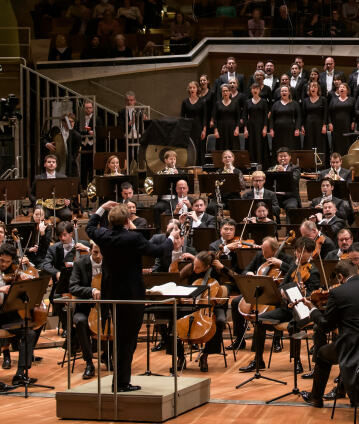
From apocalypse to apotheosis – in his Second Symphony, Gustav Mahler explores one of humanity’s great questions: “Why did you live?” His music traverses the light and shadow of existence and transcends the boundaries of the genre. Mahler incorporated folk songs from Des Knaben Wunderhorn and a moving choral finale. The composer described the experience as like being “clubbed to the ground and then lifted to the highest heights on angels’ wings”. The conductor is Daniel Harding.
“Such enthusiasm is seen only once in a lifetime! I saw men weeping and, at the end, young men throwing their arms round each other’s necks. The impression was indescribable!” It was Justine, Gustav Mahler’s sister, who attempted here to describe what can hardly be described: the impact that Mahler’s Second Symphony had at the world premiere of the complete work in Berlin on 13 December 1895. While the audience willingly allowed themselves to be carried away by the work’s enormous scale, its unprecedented effects and the sacred, sublime choral finale, the critics could not resist finding fault: there was talk of the “misuse of percussion instruments” and “grotesque combinations of sounds”.
Mahler himself struggled considerably with the composition of his Resurrection Symphony. Its creation spanned six years. First, the composer completed the opening movement, a harrowing funeral march lasting around 25 minutes: “I have,” said Mahler, “called the first movement Funeral Rites (Todtenfeier), and if you wish to know, it is the hero of my Symphony in D major [No. 1] who I am laying to rest there, and whose life I am reflecting, from a higher vantage point, in a pure mirror.” But Mahler’s work was not to end with the death of the Titan alone. Despite professional duties and personal pressures, he composed two further movements. He found himself at a standstill when it came to the finale: what could he possibly set against such a profound first movement? He received his inspiration in 1894 at Hans von Bülow’s funeral: “There, the choir sang Klopstock’s chorale Aufersteh’n! from the organ.” The text was to form the basis of his choral finale – and the ultimate answer to the questions addressed by Mahler’s Second: “Why did you live? Why did you suffer? Is it all just one big, terrible joke? Anyone in whose life this cry has once resounded must provide an answer; and I give that answer in the final movement.”
Within this structurally and thematically coherent framework, we find a peaceful andante – described by Mahler as the “melancholy memory of his youth and lost innocence”, a scherzo based on the song Des Antonius von Padua Fischpredigt, presented as a “satire on humankind”, and Urlicht, sung by the alto – “the moving voice of naive faith”. The latter forms a delicate bridge from the theatrum mundi to the otherworldly spatial music of the great call, followed by the apocalypse and the organ-accompanied promise of resurrection. Indescribable.
Berliner Philharmoniker
Daniel Harding
Johanna Wallroth
Marianne Crebassa
© 2026 Berlin Phil Media GmbH
Related interview