Lontano: Spatial music with the Berliner Philharmoniker
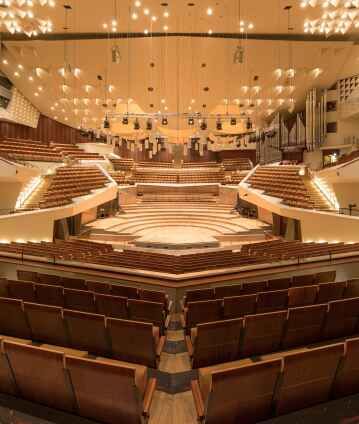
The relationship between music and space is multifaceted: compositions can be inspired by architectural structures; St Mark’s Basilica, for example, not only had a formative influence on Venetian polyphonic music, but Wolfgang Rihm also highlighted its acoustic qualities in his music – as he did, later on, with the Philharmonie Berlin. Spatial effects can also arise purely through musical means, for example through choirs or instruments positioned at a distance – “lontano”. Richard Wagner is arguably a unique case: he had the Bayreuth Festival Theatre built as the ideal space for his music.
In the 16th century, Nicolaus Copernicus put forward the heliocentric model of the universe, painting rediscovered perspective, and, as a result of the “discovery” of the Americas, the geographical world known to Europeans continued to expand. This new awareness was also reflected in music. From the “two-dimensional” antiphon principle of question and answer, “spatial” polyphony developed, which ultimately unfolded magnificently in the three dimensions of space in Venetian polychoral music – not least visually: just like the instrumental sections in Giovanni Gabrieli’s Canzon septimi et octavi toni à 12, choirs sang from the church galleries at the time, their voices coming from various directions.
Wolfgang Amadeus Mozart has four orchestral groups interact with one another in his Notturno, creating delightful echo effects. Richard Strauss also made use of such effects in his Alpine Symphony: here, the “hunting horns from afar” echo across the stage from a 16-piece orchestra behind the scenes. Gustav Mahler mastered the use of spatially separated sound sources. His symphonies contain precise instructions such as “at a great distance”, “from the opposite direction” and “positioned in isolation”. At the end of his Second Symphony, he separates the earthly realm of the stage from the heavenly realm of the Last Judgement, before reuniting them in the promise of the Resurrection.
In his unfinished oratorio Die Jakobsleiter, Arnold Schoenberg composed a work that reflected his worldview, featuring a vast ensemble. The precise design of the spatial sound transforms the performance into an existential experience: Schoenberg’s requirement for the “distant, high, low” positioning of the distant ensembles anticipates what can only now be reproduced through Immersive Audio (Dolby Atmos) – he even considered having groups play in “acoustically separate rooms” that “become audible by means of microphones placed in remote locations”. Finally, in 1957, György Ligeti’s Lontano had entire soundscapes glide through the space as clusters: “When I first conceived of these delicate, intermingling, quasi-fluid crystalline formations, they became associated in my mind with a sense of great spatial and temporal distance.” Here, one might perhaps gain a glimpse of what Gurnemanz’s enigmatic remark in Wagner’s Parsifal alludes to: “Here, time becomes space.”