Jakub Hrůša and Seong-Jin Cho at the Baden-Baden Easter Festival
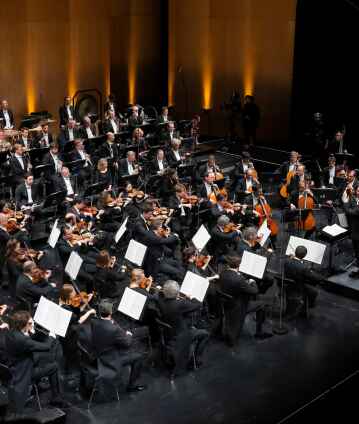
This concert marked the Berliner Philharmoniker’s farewell to Baden-Baden, their second home. The orchestra had presented an opera and several concerts each year at the Easter Festival in this idyllic spa town since 2013. The highlight of the guest performance, conducted by Jakub Hrůša, was Béla Bartók’s Concerto for Orchestra, a famous farewell piece. In addition, Artist in Residence Seong-Jin Cho performed Beethoven’s Piano Concerto No. 5.
Béla Bartók was from Hungary. He loved life in the countryside, far from the hustle and bustle of the city – and, above all, folk music. He was a keen collector of peasant songs, which he then published and incorporated into his own musical language. However, after the Hungarian government allied itself with Hitler’s Germany, Bartók was forced to emigrate in 1940: “Away from here, from the vicinity of this plague-stricken land, where Wotan and his earthly representatives reign.”
New York did not become a new home for the noise-sensitive Bartók – not even professionally: the composer, who was revered in Hungary, was unable to gain a foothold with American orchestras. To make matters worse, socially isolated and virtually penniless, he fell ill with leukaemia. Then, in 1943, there was an unexpected ray of hope: the conductor Serge Koussevitzky visited the terminally ill composer in the sanatorium and commissioned him to write an orchestral work. Contrary to expectations, Bartók’s condition improved and he managed to write the Concerto for Orchestra within two months – a magnum opus in which all facets of his art come together: Hungarian metres, the harmonies of Balkan folklore, festive chorales and capricious solos, earthy humour and the nostalgic glow of the Elegia. Concerto for Orchestra – the individual as part of the whole, a “musical democracy”, as it were. It may well have been Bartók’s final wish for Europe and his lost homeland.
“Beethoven was Béla Bartók’s mother tongue,” as György Ligeti once remarked. What undoubtedly linked Bartók to the Bonn-born composer was their humanist outlook. Ludwig van Beethoven composed his Fifth Piano Concerto while Napoleon was marching into Vienna in 1809. Given its magnificent, heroic sound, it is easy to see why it was given the epithet Emperor. However, it was by no means Beethoven’s former hero, Napoleon, who was being glorified here – on the contrary, the composer was plotting revenge: “Austria shall make Napoleon pay”, he noted beside the first piano entry of the “twilight-like” adagio. The solo part – performed here by the star pianist Seong-Jin Cho – is the voice that Beethoven raised in defence of his homeland and his ideals.
Leoš Janáček’s music is like “mother’s milk” for Jakub Hrůša – the city of Brno is home to both of them. The conductor opened the Berliner Philharmoniker’s final concert at the Baden-Baden Easter Festival with a suite from the forgotten opera Fate. According to Hrůša, the music is “exceptionally original and inspired”, particularly by Moravian folk music.
Berliner Philharmoniker
Jakub Hrůša
Seong-Jin Cho
© 2025 EuroArts Music International
Category
Artists
Our recommendations
- Kirill Petrenko conducts Mozart, Berg and Brahms at Suntory Hall in Tokyo
- Simon Rattle conducts Beethoven’s Ninth Symphony in Madrid
- 2002 Europakonzert from Palermo with Claudio Abbado and Gil Shaham
- 2024 Europakonzert with Daniel Harding and Lisa Batiashvili from Tsinandali (Georgia)
- Karajan conducts Brahms’s “German Requiem” in Salzburg
- The 2009 Europakonzert in Naples with Riccardo Muti