Ensemble Wien-Berlin and members of the Berliner Philharmoniker
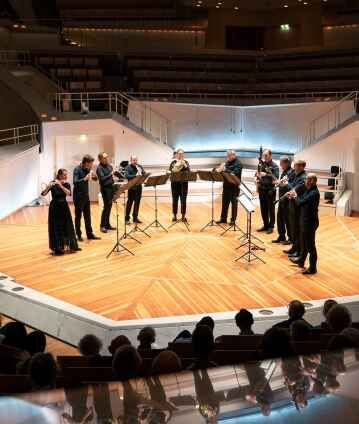
This concert is full of surprises, including a night-time serenade, a colourful animal parade and a fun wine tasting session. It begins with Mozart’s evocative Serenade in C minor, before Luciano Berio’s Opus Number Zoo transports us to rural Italy, where a hen and a fox dance together. Vinko Globokar then pokes fun at drunken musicians in Avgustin, dober je vin, and Joachim Raff revives the carefree Viennese serenade tradition in his Sinfonietta.
The serenade, whose name derives from the Italian word “sera”, meaning “evening”, was primarily intended for entertainment in the 18th century. Due to its resonant sound, the wind ensemble typical of the “Harmoniemusik” style popular in Vienna at the time was particularly well suited to outdoor evening events. Mozart, however, made it clear from the very choice of key – C minor – that his Twelfth Serenade was intended for more than just passing enjoyment. With its four movements, it approaches symphonic form, while the minuet and trio are crafted using sophisticated canon technique. The slow movement is one of luminous beauty, which Mozart stages as an intimate dialogue between the instruments.
Entertainment and depth are also combined in Luciano Berio’s Opus Number Zoo, in which the musicians also take on speaking roles. The animal characters described include not only a hen and a fox, but also a horse and a mouse. The words accompanying the neoclassical music of the then 25-year-old composer repeatedly strike a serious note, addressing the transience of life and the threat posed to creation by humankind.
The Controversial! theme for the 2025/26 season also explores the so-called “War of the Romantics” that raged in the 19th century between the followers of Liszt and Wagner on the one hand, and those of Brahms on the other. Joachim Raff, born in 1822, not only lived exactly between the eras of Wagner and Brahms, but also straddled both camps stylistically and socially. In Weimar, he orchestrated Liszt’s symphonic poems, while at the same time being friends with Brahms’s close associates, including Joseph Joachim and Hans von Bülow. The Sinfonietta, composed in 1873, which concludes with a brilliant tarantella in the style of Mendelssohn, provides an ideal introduction to Joachim Raff’s extensive body of work. For this performance, the Ensemble Wien-Berlin – which consists of members of the Berliner and Wiener Philharmoniker – will be joined by several other orchestral colleagues.
Ensemble Wien-Berlin
Members of the Berliner Philharmoniker
Jonathan Kelly
Andreas Wittmann
Gerald Pachinger
Andraž Golob
Stefan Dohr
Paula Ernesaks
Václav Vonášek
Richard Galler
Matthew McDonald
Karl-Heinz Schütz
Jelka Weber
© 2026 Berlin Phil Media GmbH
Category
Artists
Our recommendations
- An evening of chamber music with Christian Tetzlaff and members of the Berliner Philharmoniker
- Philharmonic String Quartet: Music of remembrance
- Brahms Ensemble Berlin with works by Mendelssohn, Bruckner and Brahms
- Philharmonic chamber music: The fascination of the clarinet
- Philharmonic chamber music: On the trail of your own identity
- Chamber music with Bolero Berlin: From the sarabande to the tango