Brahms Ensemble Berlin with works by Mendelssohn, Bruckner and Brahms
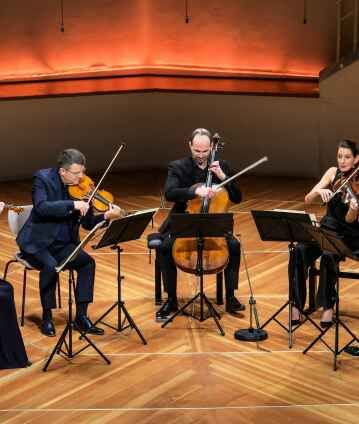
Brahms and Bruckner both loved smoked meat with dumplings, but that was where the similarities ended. According to Brahms, “Bruckner’s works are not works, but a fraud,” and the dislike was entirely mutual. This programme features Bruckner’s Intermezzo, full of Ländler rhythms, and Brahms’s Second String Quintet, which shifts between joie de vivre and melancholy. This juxtaposition is accompanied by Mendelssohn’s effervescent String Quintet No. 2.
Bruckner wrote only one major chamber music work: the String Quintet in F major, which was composed at the suggestion of violinist Joseph Hellmesberger. As Hellmesberger did not like the scherzo, the composer added the Intermezzo, a delicately sounding miniature of his symphonic scherzos, full of dance-like elegance.
In stark contrast to Bruckner, chamber music played a central role for Brahms. So it is no surprise that he chose to bid farewell to composing with a work for a small ensemble. He wrote to his publisher about his Second String Quintet: “You can say goodbye to my music – because it is time to stop.” Fortunately, Brahms returned from his self-imposed early retirement a few months later, but the quintet can nevertheless be seen as a successful attempt to take musical stock with a wealth of different tonalities. The opening theme, played by the cello, is characterised by brightness and exuberance, while the slow movement is marked by deep melancholy, and although the piece ends with fiery Hungarian sounds, charming waltz references recall Brahms’s admiration for Johann Strauss.
Mendelssohn dedicated his Second String Quintet, composed in 1845, to the violinist Ferdinand David, as he had done with his earlier violin concerto. In the virtuosic concertante passages of the first movement, Mendelssohn undoubtedly provided a showcase for his friend’s outstanding abilities. However, the quintet was not published until after Mendelssohn’s surprising, early death, as the composer had not yet completed his planned revision of the finale. The outer movements exude energy and elegance, the adagio is marked by painful dissonances, and the enchanting andante, woven from staccato and pizzicato sounds, is one of Mendelssohn’s most beautiful scherzos.
Brahms Ensemble Berlin
Rachel Schmidt
Raimar Orlovsky
Diyang Mei
Julia Gartemann
Uladzimir Sinkevich
© 2026 Berlin Phil Media GmbH
Category
Artists
Our recommendations
- Philharmonic chamber music: On the trail of your own identity
- Chamber music with Bolero Berlin: From the sarabande to the tango
- The Berlin Phil Series: A tribute to Daniel Stabrawa
- Philharmonic chamber music: Of pilgrims, lovers and child prodigies
- “Beethoven in close-up” – part 3
- Philharmonic chamber music: Korngold, Rihm and Bruckner