Kirill Petrenko conducts Respighi and Martucci
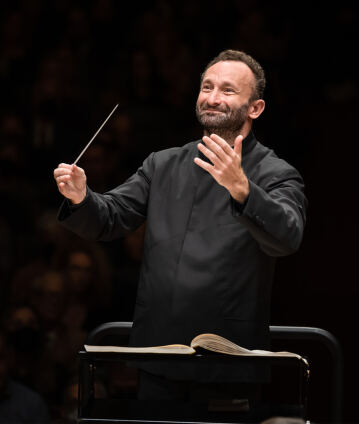
Rome! The city of Caesars and gladiators, the heart of Christianity, and the setting for joyful celebrations. It also boasts sparkling fountains, mysterious catacombs and parks with shady pine trees. With his trilogy Fontane di Roma, Feste romane and Pini di Roma, Ottorino Respighi created a musical homage to the Eternal City, whose vibrant soundscape Kirill Petrenko brings to life here. The concert begins with an evocative, lyrical Notturno by Giuseppe Martucci.
“Prima le parole, poi la musica” – first the words, then the music. With this maxim, Claudio Monteverdi set a new course for Italian music at the dawn of the Baroque era: the following 300 years were to be dominated by opera. Giuseppe Martucci’s evocative Notturno, with which chief conductor Kirill Petrenko opens this concert, also echoes one of the great masters of musical drama: Richard Wagner. Martucci, pianist and conductor, born in Campania in 1856, admired him and, amongst other things, conducted the Italian premiere of Tristan. He also taught composers at the Liceo in Bologna – including Ottorino Respighi.
Respighi achieved worldwide fame with three symphonic poems, which the Berliner Philharmoniker present here as a cycle: Fontane di Roma, Feste romane and Pini di Roma. Although they are “senza parole”, the music is nevertheless so vivid that the scenes of the Eternal City depicted in sound seem to come to life in the mind’s eye of the listener. Before Respighi moved to the Italian capital for a permanent post, he had worked in St Petersburg and taken lessons from the master of orchestration, Nikolai Rimsky-Korsakov. Rimsky-Korsakov’s influence is evident in the exquisitely iridescent music, which transforms the bubbling of Rome’s fountains into the most magnificent sound painting. Respighi wanted the nightingale’s song in Pini di Roma to be even more realistic: the score calls for the recording of real birdsong from a gramophone record.
But these works are about much more than mere illustration, as Respighi in his own words explained: In the Fontane, “the composer sought to express the feelings and visions that arose within him at the sight of four Roman fountains, each time at the hour of day when their character most harmonises with their surroundings, or when their beauty makes the greatest impression on the beholder”. The impressionistic approach lends these sound paintings emotional depth; Respighi evokes sensory experiences ranging from the “pastoral landscape in fresh, soft mist” to the sky that hangs “gloomily over the Circus Maximus”’. And what is more: space and time flow into one another. The sight of the Fontana del Tritone in the morning leads Respighi’s imagination into the world of Greek mythology, and the pine trees planted in pre-Christian times become the starting point “for evoking memories and visions”, as the ancient trees “bear witness to the most significant events in Roman life”.
This intersection of the centuries is significant for Respighi: he had a passion for Early music throughout his life, and revived it through his arrangements – including his orchestral transcription of Monteverdi’s Lamento d’Arianna, which the Berliner Philharmoniker performed under Arthur Nikisch with soloist Julia Culp in 1908.
© 2026 Berlin Phil Media GmbH