Paavo Järvi and Christian Tetzlaff
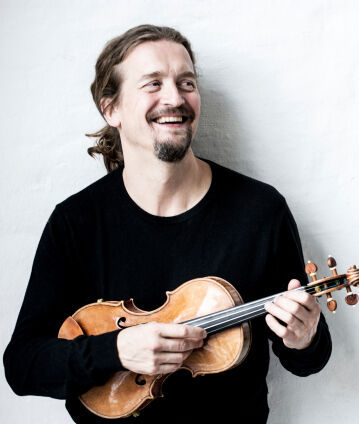
Violinist Christian Tetzlaff’s approach when performing Dimitri Shostakovich’s Second Violin Concerto is to “listen to your inner self and take your time”. The work is a fascinating example of the composer’s late style. The dialogue between the orchestra and the violin unfolds with exquisite delicacy, before both are swept away in a dance-like finale. Contrasting this is Sergei Prokofiev’s Fifth Symphony, composed as a “hymn to the free and happy man”. The conductor is Paavo Järvi.
“When we were growing up in Estonia,” Paavo Järvi once said, “Arvo [Pärt] was, to me and my sister, our father’s cool friend.” The conductor’s early acquaintance with the composer developed into a close artistic partnership. In Paris in 2010, Järvi conducted the world premiere of the tone poem Silhouette, which was dedicated to him. The work, which perfectly exemplifies the accessible, evocative style of Pärt – now over 90 years old – was inspired by the architecture of the Eiffel Tower.
Like Dmitri Shostakovich’s First Violin Concerto, which is performed more frequently, the Second, which Christian Tetzlaff performs here with the Philharmoniker, is also dedicated to the great violinist David Oistrakh. Shostakovich had intended to present the concerto to him as a gift for his 60th birthday. However, he miscalculated, with the result that Oistrakh premiered it in 1967 at the age of 59 – and on the actual milestone birthday, he then presented him with a violin sonata. The concerto is characterised by a contemplative, at times even melancholic mood. The first two movements end gently, the last one abruptly, and Shostakovich prescribed a fast tempo only for the allegro section of the finale. All movements contain cadenzas in which the soloist develops the material in a manner that is both meditative and virtuosic.
Together with his Symphonie classique, Sergei Prokofiev’s Fifth Symphony is his best-known contribution to the genre. Traditionally structured in four movements, Prokofiev’s idiom also incorporates stylistic elements from the golden age of symphonic music. The second movement, for instance, is an original variation on the Classical-Romantic scherzo with its A-B-A structure. Although the outer movements contain their share of sombre moments, the work – which was premiered at the end of the Second World War – never strikes a martial note. The finale is intended to sound “giocoso” – that is, joyful and playful. Prokofiev could only imagine the “free and happy person” as someone whose imagination unfolds through play.
© 2027 Berlin Phil Media GmbH
Artists
Our recommendations
- An evening of chamber music with Christian Tetzlaff and members of the Berliner Philharmoniker
- Octets by Franz Schubert and Jörg Widmann
- The National Youth Orchestra of Germany with Karl-Heinz Steffens and Christian Tetzlaff
- Benefit concert “Together for humanity”
- Simon Rattle conducts Beethoven and Mendelssohn at the Waldbühne
- Brahms’s Violin Concerto with Christian Tetzlaff and Simon Rattle