Berliner Philharmoniker Ensembles: Beethoven and Mendelssohn
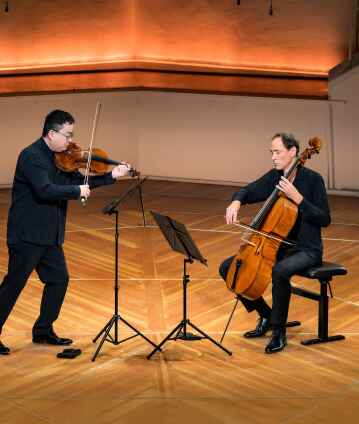
This season, the Berliner Philharmoniker Ensembles series is dedicated to Ludwig van Beethoven, the 200th anniversary of whose death falls in 2027. His Große Fuge (Great Fugue) is astonishingly modern, a quality that baffled his contemporaries. But not the young Felix Mendelssohn: shortly after the death of his role model, Mendelssohn composed a string quartet in which he alludes, among other things, to the Große Fuge. The programme opens with Beethoven showing his humorous side – in the Serenade in D major and the Duet with two obligato eyeglasses.
From string duet to trio and on to quartet: the first half of this concert vividly illustrates how Beethoven moved towards the supreme genre of chamber music. While the composer wrote his duet for viola and cello and all five of the string trios before 1798, he did not publish his earliest series of quartets until the beginning of the 19th century.
In the 18th century, the genre of the serenade was synonymous with light entertainment. The march, which features as the first and last movements of Beethoven’s opus 8, frames the work. The middle movements include a humorous dance in the Polish style and an expressive adagio, in which the violin and viola play in unison to the gentle accompaniment of the cello.
With the whimsical reference to “eyeglasses” in the title of the Duet in E flat major, Beethoven alluded to his poor eyesight, which he shared with the work’s probable dedicatee – a nobleman and amateur cellist. Perhaps the composer, who had worked as an orchestral violist in his youth, intended to play this part himself. The unfinished piece consists of a lyrical allegro and a witty minuet.
More than a quarter of a century separates these early works from the famous Great Fugue. It was premiered in 1826 as the finale of Beethoven’s String Quartet op. 130 and later published as a standalone work. A number of variations on the main theme are introduced in the opening overture and developed in turn in the following sections. In this masterpiece of the genre, the highly complex compositional technique produces harmonies that were unprecedentedly wild by the standards of the time.
Mendelssohn drew inspiration from Beethoven in the fugue passages of his A minor quartet and also the idea of linking different movements of a work through recurring themes. The quartet, whose finale begins with a dramatic recitative played by the first violin, is regarded as a musical response to the composer’s unhappy love affair.
Members of the Berliner Philharmoniker
Noah Bendix-Balgley
Diyang Mei
Knut Weber
Hande Küden
© 2026 Berlin Phil Media GmbH
