Sir Simon Rattle conducts Haydn’s “Creation” in Lucerne
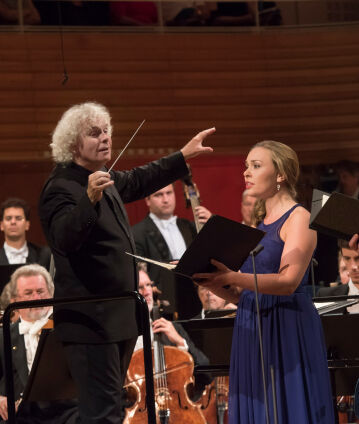
Sir Simon Rattle was once asked, “If you could only conduct one piece, which would it be?”. Without hesitation, he replied, Joseph Haydn’s Creation. For him, the oratorio is one of the “most perfect pieces, one of the wisest and wittiest” – and the epitome of the musical Enlightenment. Simon Rattle and the trio of soloists Elsa Dreisig, Mark Padmore and Florian Boesch performed this masterpiece at both the opening concert of his final season as chief conductor of the Berliner Philharmoniker, and also shortly afterwards at the 2017 Lucerne Festival.
“Never has a musical work of art caused such a sensation and found such a wide audience as J. Haydn’s Creation,” wrote the Journal des Luxus und der Moden in 1801. How could a sacred work become so popular at the height of the Enlightenment? The first key to its appeal is probably the curious fact that Haydn conceived the oratorio in two language versions – one in German and one in English. However, the English translation provided by Haydn’s patron Gottfried van Swieten is so stilted that even in English-speaking countries, The Creation is usually heard today in German. The music itself is likely more decisive. Right from the start, the audience at the time must have rubbed their ears in disbelief: the composed chaos, the Big Bang and the overwhelming coming into being of light are not only extremely effective, but also incredibly modern in Haydn’s treatment.
Haydn depicts the story of creation as a compelling narrative, with both dramatic flair and evocative imagery. This music is accessible, engaging and immediate, yet the composer manages to avoid falling into the trap of simplistic naivety, even when onomatopoeically imitating animal sounds. Haydn attached great importance to the dramatic structure of his oratorio, as is shown in a performance in Vienna, for which he asked in the theatre programme that there be no applause between movements, “because otherwise the precise connection between the individual parts, from whose uninterrupted sequence the effect of the whole is supposed to arise, would necessarily be destroyed, and the enjoyment would be noticeably diminished”.
Finally, the Enlightenment also finds direct expression in The Creation. The libretto initially follows the biblical account in which God creates the world and its living creatures. In the aria “Mit Würd und Hoheit angetan” (In native worth and honour clad), which celebrates the creation of man, the latter is remarkably attributed with courage and wisdom, central virtues of the Enlightenment – and even more, he is, as it were, deified by his own intellect: “In his eyes with brightness shines the soul, the breath and image of his God.”
Berliner Philharmoniker
Sir Simon Rattle
Elsa Dreisig
Mark Padmore
Florian Boesch
Rundfunkchor Berlin
© 2017 Accentus Music
Category
Artists
Our recommendations
- The Berliner Philharmoniker, Simon Rattle and Karita Mattila at the “Proms”
- Simon Rattle conducts Bruckner, Ravel and Hosokawa in Taiwan
- Simon Rattle conducts “Tosca” in Baden-Baden
- Sir Simon Rattle and Ian Bostridge at the Lucerne Festival
- Simon Rattle conducts Wagner’s “Götterdämmerung” at the Festival d’Aix-en-Provence
- Claudio Abbado conducts works with a maritime theme at the 1998 Europakonzert from Stockholm