Interview
“Upbeat”: Gustav Mahler’s Symphony No. 8
Kirill Petrenko conducts Mahler’s Eighth Symphony
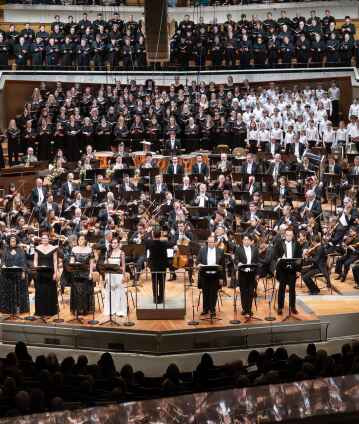
“Symphony means constructing a world with all the technical means at one’s disposal.” Nowhere did Gustav Mahler realise this credo more impressively than in his Eighth Symphony. With eight soloists, three choirs and a gigantic orchestra, it goes beyond anything that came before. At the same time, Mahler brings together fundamental ideas of intellectual history in this profusion of sound – from medieval hymns to the conclusion of Goethe’s Faust. After 15 years, the Berliner Philharmoniker are bringing the work back to the concert stage under the baton of Kirill Petrenko.
In the summer of 1906, Mahler was seized by the “spiritus creator”, which took hold of him and shook him until, within a few weeks, according to the composer, “the greatest work was finished”: his Eighth Symphony. Having previously declared that he had created entire worlds in sound, his opus summum, conceived as such, was to literally encompass the cosmos in the form of an 80-minute symphonic cantata with a huge orchestra: “Imagine that the universe begins to ring and resound,” he wrote to his friend, the conductor Willem Mengelberg.
The audience was overawed by the Eighth. The 9th-century Pentecost hymn “Veni, creator spiritus” and the final scene of the second part of Goethe’s Faust seem worlds apart. But for Mahler, they were kindred spirits: here, the elemental creative spirit is invoked, while there, a creative individual attempts to overcome the inadequacy of his existence. The central message of the Eighth expresses what the Second Symphony merely hints at in the words “You have not lived in vain”: “Whoever strives and endeavours, / we can redeem.”
Mahler clearly and consistently shapes the Eighth from his creative impulse, in which two main themes dominate: the introductory, ancient yet sublime “Veni” theme, and the melody to the words “Accende lumen sensibus, / infunde amorem cordibus” (Light the light of our senses, / pour love into our hearts), which, according to the composer, forms the “bridge” to the operatic, scenic Faust section. As in his Third Symphony, Mahler also expresses his love for the highest, redeeming power in his Eighth Symphony – embodied in the texts by the “eternal feminine” in the form of Gretchen and the Mater Gloriosa. Flanked by the “Veni” theme in the off-stage orchestras and underpinned by the organ, the love theme is transfigured in a light-filled apotheosis. As a symbol and direct expression of a radiating “spiritus creator”, Mahler’s Eighth itself becomes a quasi-liturgical Pentecostal rite.
Berliner Philharmoniker
Kirill Petrenko
Jacquelyn Wagner
Golda Schultz
Jasmin Delfs
Beth Taylor
Fleur Barron
Benjamin Bruns
Gihoon Kim
Le Bu
Rundfunkchor Berlin
© 2026 Berlin Phil Media GmbH
Related interview
Artists
Our recommendations
- Kirill Petrenko conducts Beethoven’s Ninth Symphony at the Brandenburg Gate
- Simon Rattle conducts “Weltethos” by Jonathan Harvey and Hans Küng
- Sakari Oramo conducts “Das Lied von der Erde” at the Mahler Festival Amsterdam
- Daniel Barenboim conducts Verdi’s Requiem
- Bach’s “St John Passion” with Simon Rattle and Peter Sellars
- Sir Simon Rattle conducts Haydn’s “Creation” in Lucerne