Interview
“Upbeat”: Igor Stravinsky’s “Pulcinella” suite
Kirill Petrenko and Gautier Capuçon
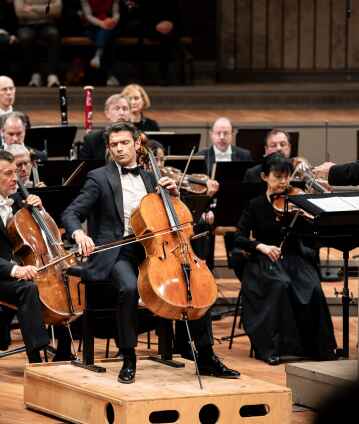
Ludwig van Beethoven rebelled against his developing deafness with his optimistic Second Symphony. There are occasional flashes of the uncompromising nature of his later works, but the symphony is still rooted in the perfectly balanced music of his teacher Haydn. Stravinsky in turn revived Baroque and Classical stylistic elements in his Pulcinella, while Tchaikovsky’s Rococo Variations are an homage to Mozart. The virtuoso cello part is played by Gautier Capuçon, with Kirill Petrenko conducting.
What does the music of the 18th century sound like? Or rather: what does it sound like? This is the question that the Philharmoniker and their chief conductor address in this programme. Pyotr Ilyich Tchaikovsky, who was born in the Romantic era, longed to return to a bygone sound world with his Variations on a Rococo Theme: the Rococo – an era more commonly associated with the visual arts – is characterised by a playful elegance, such as that found in Mozart’s style. “I don’t just love Mozart,” said Tchaikovsky, “I idolise him. It is thanks to Mozart that I have devoted my life to music.” The eight Rococo Variations, clearly inspired by his musical hero, were premiered in 1877 – at a time when the composer was increasingly suffering as a result of an unhappy marriage of convenience intended to conceal his homosexuality. With a cheerful atmosphere, peppered with lively trills yet tinged with melancholy undertones, Tchaikovsky develops the theme with increasing rhythmic complexity. In Gautier Capuçon, the Philharmoniker welcome a master of musical refinement, whose passionate playing brings out the best in both the Classical and Romantic elements of this music.
In his 1920 ballet Pulcinella, Igor Stravinsky looks even further back into musical history – to the time of Giovanni Battista Pergolesi. While Stravinsky draws inspiration from Pergolesi’s melodies, he infuses them with his own rhythms and harmonies – and an emotional detachment that would come to define his Neoclassical creative phase: “Pulcinella,” said the composer, “was my rediscovery of the past, the epiphany that made my later work possible. Of course, it was a look back – the first of many love affairs in that direction – but it was also a look in the mirror.” The suite from the ballet performed here was compiled by Stravinsky himself.
Ludwig van Beethoven conducted the premiere of his own Second Symphony at the Theater an der Wien in 1803. The work can be seen as a bridge between the Classical and Romantic eras – with Beethoven looking towards the future.
Berliner Philharmoniker
Kirill Petrenko
Gautier Capuçon
© 2026 Berlin Phil Media GmbH
Related interview
Artists
Our recommendations
- Europakonzert 2012 from Vienna with Gustavo Dudamel and Gautier Capuçon
- Semyon Bychkov and Gautier Capuçon
- 2026 Europakonzert with Kirill Petrenko and Gautier Capuçon from Esterházy Palace
- Kirill Petrenko and Frank Peter Zimmermann
- Kirill Petrenko conducts Tchaikovsky’s “Iolanta”
- Kirill Petrenko conducts Korngold, Mozart and Norman