Interview
Víkingur Ólafsson in conversation with Allan Nilles
Semyon Bychkov and Víkingur Ólafsson
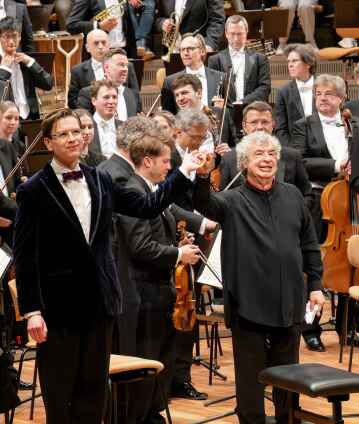
While the Napoleonic Wars were raging, Ludwig van Beethoven created one of his most brilliant works: the Fifth Piano Concerto – played here by Víkingur Ólafsson – defies the challenges of the time with its heroic optimism. Semyon Bychkov then conducts Dmitri Shostakovich’s Fifth Symphony, composed in the shadow of Stalinist tyranny. Triumphant at first glance, it reveals an ironic ambiguity – a work that feigns rejoicing and undermines it at the same time.
It is 1809: Beethoven is almost completely deaf and deeply shaken by the ongoing war around Vienna. His former admiration for Napoleon has turned to bitter opposition. What has become of the ideals of the French Revolution – liberty and fraternity – which the composer believed in as a young man? For his Piano Concerto No. 5, Beethoven chose the key of E flat major, the key of the Eroica. The piano opens the first movement confidently with a majestic cadenza; the movement is characterised by a stately march-like quality. The intimate adagio – one of the most moving slow movements in the piano repertoire – floats like a heavenly, comforting idyll in the middle of the work. The finale, which follows immediately after a suspenseful transition, exudes an unbridled, almost frenzied joy. “It must be played not like a smile, but like a grin,” Lars Vogt once remarked, “man is born to be free. And freedom – can be fought for”. Following his debut with John Adams’s original Piano Concerto, Víkingur Ólafsson now presents a popular classic from the repertoire.
Beethoven’s Coriolan overture, composed around the same time and which opens the programme, also centres on a questionable hero – one who is ultimately broken. The second half features Dmitri Shostakovich’s Fifth Symphony, a work of unparalleled complexity that answers the question of how an artist can voice his protest whilst risking his life. Here, in 1937 – already in the regime’s sights – the composer achieved a masterstroke: while outwardly feigning conformity with the aesthetics of the Soviet dictatorship, he distorts heroic elements such as march rhythms into grotesque caricatures. The concert is conducted by Semyon Bychkov, a Shostakovich expert with a particular feel for the existential urgency of this music.
Berliner Philharmoniker
Semyon Bychkov
Víkingur Ólafsson
© 2026 Berlin Phil Media GmbH
Related interview
Interview
Semyon Bychkov in conversation with Allan Nilles