Philharmonic chamber music: Mozart versus Salieri
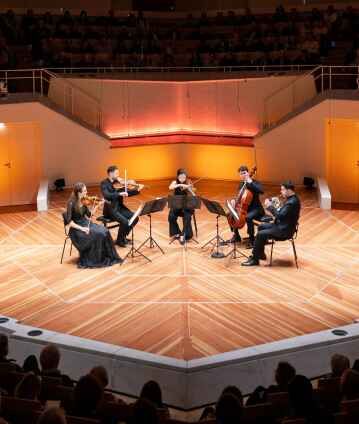
Antonio Salieri does not enjoy a good reputation in the music world: as Mozart’s jealous rival, he is even – according to legend – said to have poisoned him. Miloš Forman’s film Amadeus also depicts Salieri as a mediocre, scheming composer. However, he was extremely successful during his lifetime. But are his works on a par with Mozart’s? Members of the Berliner Philharmoniker contrast two string quartets by Salieri with works by Mozart, including the amiable Horn Quintet.
Had it not been for the rumours that Salieri was responsible for Mozart’s death, the long-serving Kapellmeister at the Viennese court would surely have been assured of a respectable place in music history. In addition to being a prolific composer, Salieri was also the teacher of Beethoven, Schubert and Liszt. The spirited scherzi “di stile fugato” in this programme demonstrate his consummate mastery of the sophisticated technique of counterpoint. As both works are written for string quartet, Mozart’s Adagio and Fugue provides a direct point of comparison.
With his six string quintets, Mozart established a tradition that was later continued by composers including Mendelssohn, Brahms and Bruckner. Mozart added a second viola to the string quartet line-up – an instrument that he himself liked to play, and in some private performances of the quintet, Mozart and Joseph Haydn formed what is probably the most distinguished viola duo in history. The C major work, which delights with its captivating dialogues between the violin, cello and viola, ranks among the composer’s most expressive contributions to chamber music in terms of both harmony and form.
We also owe the quality of Mozart’s numerous works for wind instruments to the composer’s friendships with outstanding instrumentalists. Mozart wrote his only horn quintet and four solo concertos for Joseph Leitgeb, who he had met as a colleague of his father’s in the Salzburg orchestra. Like three of the concertos, the quintet is in E flat major, as this key was particularly well suited to the horn – which at that time still had no valves – and allowed its warm sound to unfold in long, melodious lines.
Members of the Berliner Philharmoniker
Johanna Pichlmair
Rachel Schmidt
Tobias Reifland
Moritz Karl Huemer
László Gál
Kyoungmin Park
© 2026 Berlin Phil Media GmbH