Philharmonic chamber music: Schoenberg and Shostakovich
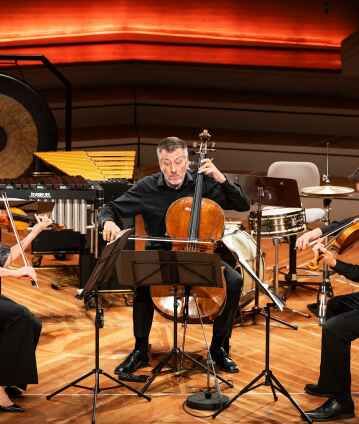
As part of the season’s Controversial! focus, musical worlds collide – in this case, those of Arnold Schoenberg and Dmitri Shostakovich. The programme includes two witty and ironic arrangements by Shostakovich, who considered Schoenberg’s twelve-tone music to be “meaningless play with sounds”: the Suite for Variety Orchestra, better known as “Jazz Suite No. 2”, and the allusion-filled Symphony No. 15. Schoenberg’s String Trio, on the other hand, is an impressively complex work – and yet very expressive.
Arnold Schoenberg wrote his only string trio in 1946 while in exile in California. The composition was preceded by what he himself described as his own “death”: he had suffered cardiac arrest and could only be saved by an adrenaline injection into his heart. Although tightly constructed and technically demanding, the work, whose five sections flow seamlessly into one another, is very expressive. Several dance-like passages are a possible reference to the composer’s Viennese homeland.
Although Dmitri Shostakovich categorically rejected Schoenberg’s method, he integrated serial techniques into his own works on several occasions in later years. In his last symphony, No. 15, they appear alongside quotations from Rossini’s Guillaume Tell and Wagner’s Valkyrie, as well as allusions to the music of Beethoven and Berg, funeral marches, and chorale-like themes. Similar to the last completed symphonies by Tchaikovsky and Mahler, this work also ends with a grand adagio. Was Shostakovich composing a farewell to the genre or a tongue-in-cheek potpourri? Any answer would be pure speculation. What is certain is that Shostakovich was severely ill and exhausted when he composed the symphony. Knowing this, the mysterious-sounding final minutes of the piece, dominated by percussion, could be seen as evoking the sounds of life-support machines in a hospital.
The arrangement for piano trio and percussion, written in 1972, the year of the premiere, and presented here by members of the Berliner Philharmoniker, was authorised by Shostakovich and included in his catalogue of works. This late piece is followed by the composer’s Suite for Variety Orchestra, probably written in the 1950s. Shostakovich compiled it from piano pieces and numbers that he had originally written for a variety of films and a ballet. They reveal him to be a gifted creator of lively, catchy tunes – such as the famous Second Waltz, which has been used in Stanley Kubrick’s film Eyes Wide Shut, among others.
Members of the Berliner Philharmoniker
Cornelia Gartemann
Allan Nilles
Ludwig Quandt
Hendrik Heilmann
Simon Rössler
Franz Schindlbeck
Jan Schlichte
© 2025 Berlin Phil Media GmbH