Pangaea Trio Berlin with works by Shostakovich, Ravel and Brahms
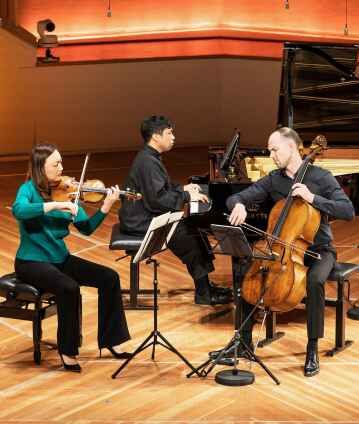
The Pangaea Trio Berlin is named after the primordial continent that once united all the continents of the Earth, highlighting the multicultural origins of its members. This programme is just as diverse: Shostakovich was 16 years old and in love for the first time when he wrote his wistful Piano Trio No. 1. Ravel’s Piano Trio combines French elegance with Basque rhythms. Brahms’s Piano Quintet is imbued with the dark, contemplative, and dramatic characteristics of late German Romanticism.
Shostakovich, then a 17-year-old music student, dedicated his First Piano Trio to Tatiana Glivenko, who he fell in love with at a health resort in Crimea. The Romantic tone, which is rather uncharacteristic of the composer, is particularly evident in the languid second theme. The sharply humorous treatment of the first theme, on the other hand, already points towards Shostakovich’s later style.
Maurice Ravel completed his long-planned piano trio in 1914 in the Basque Country, where his mother was from. The First World War broke out while he was composing it. Ravel – who volunteered for military service – subsequently completed a piece in five weeks that would otherwise have taken him five months, as he wrote to his colleague Igor Stravinsky. The delicate sound texture of the trio is characterised by arpeggios, harmonics and pizzicatos. The sophisticated second movement, entitled Pantoum, is modelled on the structure of the Malaysian poetic form of the same name.
Johannes Brahms had originally conceived his only Piano Quintet as a string quintet with two cellos – an unusual instrumentation that harks back to Franz Schubert. This connection is made all the more evident by quotations from Schubert’s String Quintet, which Brahms discreetly weaves into his composition. Before the work became the Piano Quintet we know and love today, Brahms produced a version for two pianos. In addition to its great thematic ingenuity, it is particularly the fusion of piano and strings – at times chamber-music-like, at others almost orchestral – that makes the work so effective. The symphonic ambition is also reflected in the structure of the four movements: the first movement is dominated by a deep solemnity – a tone that the introduction to the finale takes up again cyclically. The middle movements are a graceful Andante and a Ländler that begins with an unusual syncopation and has a melancholic quality. However, it is the folk-inspired theme of the finale that provides the most striking contrast to the predominantly sombre mood.
Pangaea Trio Berlin
Marlene Ito
Uladzimir Sinkevich
Yannick Rafalimanana
Angelo de Leo
Amihai Grosz
© 2026 Berlin Phil Media GmbH