First time in Japan: the Berliner Philharmoniker and Karajan in Tokyo in 1957
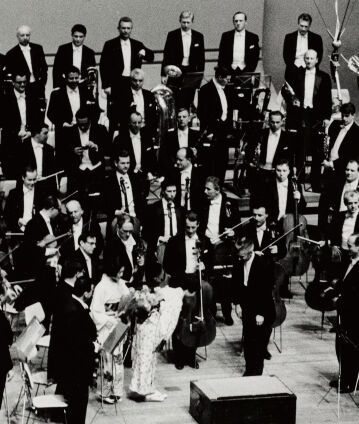
It was the beginning of a wonderful friendship that transcended borders: in October 1957, the Berliner Philharmoniker and Herbert von Karajan travelled to Japan for the first time. The orchestra and its chief conductor were greeted at Tokyo airport as if they were superstars, and queues formed outside the concert hall. NHK broadcast the concert live on Japanese radio and television using what was then the most advanced stereo recording technology – and an audience of millions tuned in to hear Beethoven’s Fifth and Richard Strauss’s Don Juan.
It was to be the first of many tours of Japan; no other country – apart from Austria and Switzerland – has been visited more frequently by the Berliner Philharmoniker. How did the orchestra come to receive such an overwhelmingly warm welcome on its first visit to Tokyo, and how did the country become a “second home” for the Berliners? The foundation for the high regard in which classical music “made in Germany” is held in Japan was laid as early as the 19th century: as part of a wide-ranging programme of social modernisation, the government began awarding scholarships to young Japanese intellectuals from 1868 onwards, enabling them to study at the finest international institutions. Berlin was regarded – alongside Vienna – as a global centre of music, and so, around the turn of the century, many Japanese students had the opportunity to learn from composers such as Max Bruch. Back in their homeland, they shared their enthusiasm for European art music as well as their knowledge of the instrumental and compositional practices of the Classical-Romantic tradition.
Ever since that first tour, the bond between the Berliner Philharmoniker and their Japanese fans and cultural figures has been nurtured by both sides: when Karajan had to pull out of the 1986 tour due to illness, his protégé Seiji Ozawa stepped in – and went on to become a long-standing friend and later an honorary member of the orchestra. All subsequent chief conductors after Karajan have toured Japan – including Kirill Petrenko.
However, this closeness may also have arisen from a subtle similarity in attitudes: despite their different roots, the two cultures share parallels. For example, the German ideals of technical perfection and fidelity to the score are reflected in Japanese values such as diligence and mastery. Herbert von Karajan spoke on several occasions about the welcoming atmosphere that prevailed in Japan during the concerts and admired the particular appreciation of the local audience. To this day, the Philharmoniker’s fan base in Japan continues to grow steadily – perhaps it’s simply a case of good chemistry.
Berliner Philharmoniker
Herbert von Karajan
© 1957 NHK
Category
Artists
Our recommendations
- Karajan conducts Bach
- Karajan conducts Brahms’s “German Requiem” in Salzburg
- Karajan conducts Beethoven’s “Missa solemnis” in Salzburg
- 2001 Europakonzert from Istanbul with Mariss Jansons and Emmanuel Pahud
- Simon Rattle conducts Mahler and Rachmaninov in Singapore
- Claudio Abbado conducts Russian works at Suntory Hall in Tokyo