Interview
Víkingur Ólafsson in conversation with Stefán Ragnar Höskuldsson
Kirill Petrenko and Víkingur Ólafsson with Brahms and Strauss
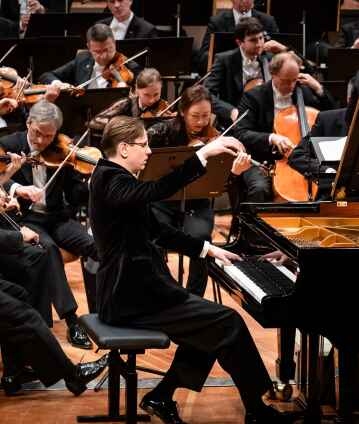
The Guardian praises the “rare, electrifying freshness” of his interpretations: Víkingur Ólafsson is currently one of the most exciting piano stars of his generation. Standing in for an indisposed Daniil Trifonov, he can be seen here with chief conductor Kirill Petrenko in Johannes Brahms’s First Piano Concerto. This is followed by Richard Strauss’s dramatic, mystical and richly colourful Also sprach Zarathustra, which describes the philosopher of the same name’s journey to humanity.
In the autumn of 1854, 20-year-old Brahms is on a long hike along the Rhine. On the spur of the moment, he decides to pay an unannounced visit to Robert and Clara Schumann – a decisive moment in his career and his life. A deep friendship, based on mutual respect, quickly develops between the couple and Brahms. Robert Schumann attempts suicide shortly afterwards by jumping into the Rhine. After being rescued, he is admitted to a sanatorium, and Brahms remains at Clara’s side. Romantic feelings enter into the relationship between this unconventional couple – Brahms, who somes from a humble background, is 14 years younger than the upper-middle-class concert pianist. During this period, Brahms composes his First Piano Concerto, captivated by Clara, but loyal to his friend and patron Robert. With a running time of almost 50 minutes, it comes across as a colossus, yet avoids superficial virtuosity. The energetic outer movements frame an intimate adagio, which the composer describes as a “gentle portrait” of his muse. Years later, he was to throw the love letters that he and Clara had exchanged over a long period into the Rhine.
Following the final rehearsal of Also sprach Zarathustra in 1896, Richard Strauss declared, “It was by far the most significant, the most perfectly formed, the most interesting and the most distinctive of my works”. Friedrich Nietzsche wrote the text following a mystical experience while hiking in Switzerland, which moved him to tears of joy. Strauss, too, had been an avid hiker since his youth. The alternation between C major and B major, which characterises the tone poem, can be interpreted as the eternal polarity of nature and humanity. Strauss portrays what is arguably the most famous sunrise in the history of music at the beginning of the work with fanfares and powerful timpani beats – an encounter with the grandeur of nature rendered in sound.
Berliner Philharmoniker
Kirill Petrenko
Víkingur Ólafsson
© 2026 Berlin Phil Media GmbH
Related interview
Artists
Our recommendations
- Semyon Bychkov and Víkingur Ólafsson
- Santtu-Matias Rouvali and Víkingur Ólafsson
- 2024 New Year’s Eve Concert with Kirill Petrenko and Daniil Trifonov
- Season opening 2018: Kirill Petrenko conducts Beethoven and Strauss
- Season opening 2023: Kirill Petrenko conducts “Ein Heldenleben”
- Kirill Petrenko conducts Beethoven’s Ninth Symphony at the Brandenburg Gate