Zubin Mehta and Pinchas Zukerman
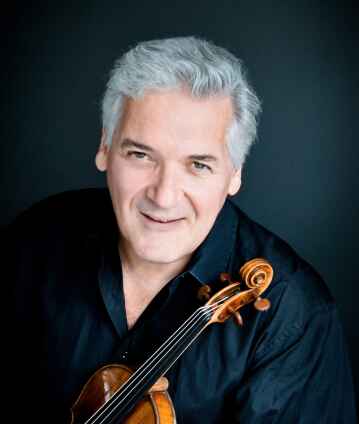
Antonín Dvořák is famous for the influence of Bohemian folk music in his compositions. In his Seventh Symphony, he reveals his more sombre, melancholy, even combative side. Max Bruch’s First Violin Concerto, in turn, captivates with its enchantingly soulful melodies and elegant virtuosity. The soloist is Pinchas Zukerman, who, like conductor Zubin Mehta, has been associated with the Berliner Philharmoniker for many years. The concert opens with Mozart’s lively Figaro overture.
Following his debut with the Berliner Philharmoniker in 1970, Pinchas Zukerman went on to enjoy an international career as a violinist, conductor, and teacher. His last appearance with the orchestra took place in 2017 as part of a charity concert. On that occasion, as on this one, the conductor was a close friend of Zukerman’s: Zubin Mehta, who has conducted the orchestra more often than any other guest conductor.
Max Bruch’s First Violin Concerto brought him a fate that, in the long run, could only frustrate a prolific composer such as himself: he became a one-hit wonder. Bruch composed many more works, including three symphonies and four operas, which – much to his chagrin – went largely unnoticed by his contemporaries. All the more reason, then, for him to curse the Violin Concerto in G minor, which premiered in 1868; with its original ideas, sumptuous tone and perfect form, it quickly became hugely popular and secured a firm place in the repertoire. The concerto owes the seemingly spontaneous virtuosity of its technically rewarding solo part to its dedicatee, Joseph Joachim, who played a key role in helping the composer to develop it. The solo violin begins with a rhapsodic cadenza, setting the melancholy, solemn tone for the movement, which Bruch described as a “Prelude”. It presents motifs that are at times tenderly lyrical, at others passionately dramatic, before returning to the opening cadenza. The second movement follows seamlessly, a soulful song without words. The final movement begins with a Hungarian dance – and the similarity to the finale of Brahms’s Violin Concerto, composed some ten years later, is no coincidence: the Hungarian Joachim had a hand in this, too.
Johannes Brahms and Antonín Dvořák shared one of the most creative artistic friendships of the 19th century. On Brahms’s recommendation, the publisher Fritz Simrock published Dvořák’s Slavonic Dances, which brought the Czech composer to prominence in 1878, although he continued to be dogged by the reputation of being merely a “Bohemian music-maker”. Six years later, the Royal Philharmonic Society commissioned him to write a symphony, and Dvořák presented his Seventh, which he had already begun, inspired by Brahms’s Third. The London premiere was an utter triumph. Its solemn, defiant character and remarkable wealth of melody placed Dvořák among the ranks of the great symphonists. In the first movement, he quotes Brahms’s lied “Immer leiser wird mein Schlummer” as a token of gratitude and a tribute to his mentor.
Much has been written about the highly productive friendship between Wolfgang Amadeus Mozart and the librettist Lorenzo Da Ponte. Through mutual appreciation and a shared, intuitive understanding of art, they created operas which are the perfect combination of text and music. The overture to Le nozze di Figaro sets the mood for the opera’s lively and humorous plot – and here, for a thoroughly entertaining programme featuring a star-studded line-up.
© 2026 Berlin Phil Media GmbH
Artists
Our recommendations
- Benefit Concert of the Federal President of Germany with Zubin Mehta and Pinchas Zukerman
- Anniversary concert with Zubin Mehta and Mahler’s First Symphony
- Zubin Mehta conducts Mahler’s Third Symphony
- A “St Petersburg Night” with Daniel Barenboim and Zubin Mehta at the Waldbühne
- Zubin Mehta conducts Bruckner and Messiaen
- Zubin Mehta conducts Mozart, Liszt and Prokofiev