From cowbells to car horns: Special effects in classical music
Chirping birds, croaking frogs and thunderstorms – even Baroque composers found ways to add special effects to their music in naturalistic tone paintings. In the age of industrialisation, even sirens and car horns could be heard in concert halls. But composers did not only resort to unusual instruments for musical special effects; they also used special playing techniques. Our playlist offers a fascinating exploration of this phenomenon – and will certainly make you sit up and take notice!
Joseph Haydn’s humorous originality has often been discussed in specialist literature – indeed, he had a flair for musical effects like few others of his time. Whether it was his onomatopoeic use of the then still young contrabassoon in The Creation, or the stage gradually emptying in the Farewell Symphony. One of his cleverest ideas remains the drum roll in the second movement of Symphony No. 94 – conducted here by Mariss Jansons – which was not used by Haydn to wake up sleepy members of the audience, but to “surprise them with something new” in London. Pyotr Ilyich Tchaikovsky wanted more than just a drum roll for his Overture solennelle “1812”, presented here by Andris Nelsons. According to the score, he wanted “an instrument used in the theatre to simulate cannon fire”.
Both George Gershwin’s An American in Paris – conducted here by Kirill Petrenko – and Edgard Varèse’s Amériques, conducted by Peter Eötvös, have a metropolitan feel, with lots of blaring car horns. The bustling impression that New York left on Varèse is created by 13 percussionists using whips, sirens and wind machines, among other things. Ottorino Respighi, on the other hand, focuses on the idyllic nature of the Eternal City in his stroll through the Pini di Roma – for the song of a nightingale, he chose the most realistic form available to him: a tape recording.
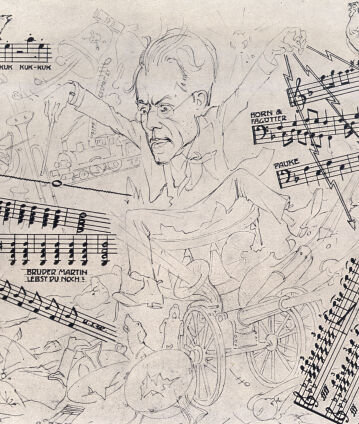
Richard Strauss and Gustav Mahler both found wonderful sounds to represent images of nature – including cowbells and thunder sheets. They also made use of spatial effects: off-stage orchestras add a new dimension to the concert experience. Mahler also succeeded in creating two parallel musical scenes on stage by having a klezmer band “pass by” while the rest of the orchestra continues to play unperturbed. The symphonist was a brilliant creator of effects: sometimes he would have the woodwinds hold their instruments “bells up”, sometimes an oboe plays a glissando “like a sound of nature”, sometimes a violin plays in scordatura, out of tune – not to mention the famous hammer blows in his Sixth. The press sometimes mocked this creativity in caricatures – today we can enjoy it to the full, as demonstrated here in the Second Symphony with Gustavo Dudamel conducting.
© 2025 Berlin Phil Media GmbH
Our recommendations
- Mariss Jansons and the Berliner Philharmoniker
- Musical Sunrises: “Let there be light!”
- From Herbert von Karajan to Kirill Petrenko: Historical milestones in the Digital Concert Hall
- Great Violin Concertos: Highlights and discoveries
- Claudio Abbado and the Berliner Philharmoniker
- Violinists with the Berliner Philharmoniker