Interview
Herbert Blomstedt about Bruckner’s Symphony No. 7
Herbert Blomstedt conducts Bruckner’s Seventh Symphony
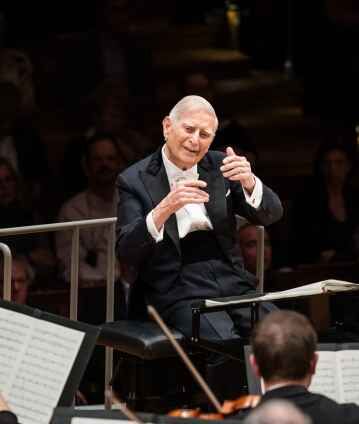
At the premiere of his Seventh Symphony, Anton Bruckner was “applauded for ¼ hour at the end”. So much acclaim – an acclaim that continues to this day – was new for the notoriously unsuccessful composer. Herbert Blomstedt surmises that the reason for its popularity is that its themes are simpler, and have “Wagnerian scope”. The conductor is an authority on Bruckner’s works – and once again has the opportunity to demonstrate his fine grasp of the emotional depth of this music with the Philharmoniker.
A mysterious tremolo from the violins, followed by the introduction of a theme that climbs two octaves within three bars, and then sings out in a seemingly endless melody. The beginning of Anton Bruckner’s Seventh Symphony is a symbolic opening of a portal to another world, a solemn, richly resonant one – with a well-measured dash of pathos. This creative expansiveness is contrasted by the adagio, a movement of enchanting inwardness – Bruckner called it “mourning music” for Richard Wagner, who he admired, and who died in 1883 while the symphony was being composed. The sprightly scherzo offers a further contrast before the finale concludes with a powerful apotheosis that builds in waves. “He stood there in his modest garb in front of the excited crowd, bowing helplessly and awkwardly,” wrote the press about the 60-year-old composer at the premiere. Bruckner was almost incredulous at the acclaim for his Seventh, which brought him his long-overdue breakthrough.
A former violinist with the Vienna court orchestra, who took part in the premiere of Bruckner’s Second Symphony ten years earlier and had become one of the leading conductors of his generation, played a significant role in this success: Arthur Nikisch. After Bruckner’s pupil Josef Schalk showed him the score of the Seventh, the conductor is said to have remarked: “I hereby give you my sacred word of honour that I will perform this symphony with the utmost care. From now on, I consider it my duty to stand up for Bruckner.” Nikisch impressively fulfilled his promise with the premiere of the Seventh in Leipzig in 1884. The symphony, which became Bruckner’s most successful during his lifetime with 33 performances, enjoys great popularity to this day – especially when conducted by an expert such as Herbert Blomstedt.
Berliner Philharmoniker
Herbert Blomstedt
© 2026 Berlin Phil Media GmbH
Related interview