Bernard Haitink conducts Schubert and Shostakovich
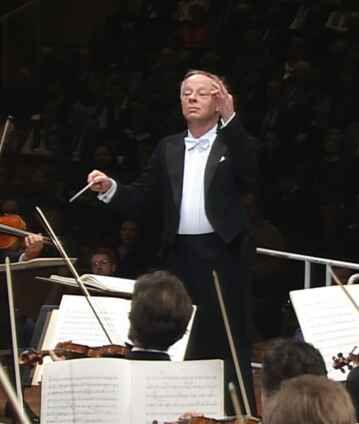
The 31st of January 1997 marked the 200th anniversary of Franz Schubert’s birth. A few days before this anniversary, Bernard Haitink, together with the Berliner Philharmoniker, presented Schubert’s Third Symphony, a youthful work brimming with joie de vivre. Dmitri Shostakovich’s Fourth Symphony provided a counterpoint: a harrowing work of epic proportions, composed under the menacing shadow of Stalinist censorship.
Even before Franz Schubert turned 20, he had composed several string quartets, six operas, almost 300 lieder – not to mention his first three symphonies. His Third, which was written in 1815, begins with an atmospheric introduction whose alternation between soft wind sounds and dramatic accents is reminiscent of an opera overture. Does it foreshadow something dramatic? No, the teenage Schubert has tricked us: suddenly, an exceedingly cheerful allegro con brio with a jaunty dotted theme comes bubbling along. Schubert pairs the allegretto’s string theme, which is reminiscent of Haydn, with a serenade-like middle section featuring wind solos. A decisive, captivating tone brings the minuet closer to Beethoven, while the tarantella finale evokes the light-footed Italian flair of Rossini. However much the influence of his contemporaries may be apparent, Schubert’s individual style is already evident. The finale in particular, with its dramatic thematic development, foreshadows the monumental movements of his later symphonies.
The combination of Classical and modern music was a frequent feature in Bernard Haitink’s concert programmes with the Berliner Philharmoniker. Here, too, the Dutch conductor, who was made an honorary member of the orchestra in 2004 after four decades of working together, contrasted Schubert’s youthful vigour with the existential power of Shostakovich. From today’s perspective, it is almost inconceivable that the latter composed while facing rigorous censorship under Stalinist cultural policy and was in constant danger of his life. The Fourth Symphony – written in 1935, then withheld for 25 years due to extreme pressure – bears witness to the composer’s distressing circumstances. “Shostakovich embraces you in this sadness,” said Haitink in an interview, “But he is cynical, perhaps sarcastic, also quirky and humorous.” He met Shostakovich in person in Moscow in 1975, shortly before the composer’s death. “He was too great a musician to be miserable,” the conductor remarked, “and what Shostakovich does to hide himself is quite another thing.”
© 1997 NHK
Artists
Our recommendations
- Bernard Haitink conducts Schubert and Shostakovich
- Bernard Haitink conducts Bruckner’s Symphony No. 4
- Bernard Haitink conducts Mahler’s Seventh Symphony
- Bernard Haitink conducts Mozart and Bruckner
- The 1999 Europakonzert in Krakow with Bernard Haitink, Emanuel Ax and Christine Schäfer
- A Beethoven evening with Bernard Haitink and Isabelle Faust