Interview
Jordi Savall in conversation with Joaquín Riquelme García
Jordi Savall makes his debut with Mozart’s “Jupiter” Symphony
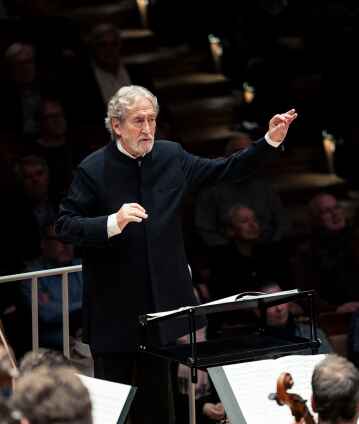
When Jordi Savall recorded Mozart’s radiant Jupiter Symphony, he thrilled listeners with a lively, high-contrast interpretation – shaped by his decades-long exploration of historical performance practice. The Catalan conductor, gambist and researcher chose this symphony for his debut with the Berliner Philharmoniker. The programme also includes Baroque music – with Jean-Philippe Rameau’s magnificent suite from Naïs, and Christoph Willibald Gluck’s groundbreaking ballet music Don Juan.
Baroque musical theatre was all about ostentatious splendour and spectacular effects: virtuoso singing that was highly ornamented, ballet interludes, and sophisticated stage technology provided a feast for the eyes and ears that made it easy to forget that the underlying material – mostly ancient myths and legends – sometimes had little entertainment value of its own. Jean-Philippe Rameau’s pastorale héroïque Naïs was written as an “opéra pour la paix” for the celebrations organised by Louis XV in France after the Treaty of Aix-la-Chapelle in 1748. The prologue pays homage to Jupiter, father of the gods, who defends Mount Olympus against attacks by the giants and titans – an unmistakable allusion to the Sun King for the delighted audience of the premiere.
“My intention was to purify music of all the abuses that had crept into Italian opera as a result of the vanity of singers and the excessive indulgence of composers, and which transformed this most magnificent and beautiful of all spectacles into the most ridiculous and boring.” These are the words of Christoph Willibald Gluck, a committed reformer, who turned the opera world of the 1760s upside down in the artistic climate of burgeoning Classicism. He wanted genuine emotional expression rather than the representation of emotion – not only in opera, but also in ballet. His music for Don Juan kept this promise – and made history: it was one of the first fully performed ballets en action, as a dramatic plot was presented without spoken or sung text, using only gestures, facial expressions and music.
Mozart’s Jupiter Symphony, with which Jordi Savall concludes this Classical programme, forms a double link to the beginning: its impressive final fugue is a tribute to Bach and Handel. Its nickname (presumably coined by violinist Johann Peter Salomon) elevates not only the symphony’s overwhelmingly artistic music to Olympian heights, but also its creator – and at the same time embodies a central idea of the Enlightenment: “Then the earth is a heavenly kingdom, /and mortals are like gods,” as it says in The Magic Flute, which Mozart quotes in the final bars of the symphony.
Berliner Philharmoniker
Jordi Savall
© 2025 Berlin Phil Media GmbH
Related interview
Artists
Our recommendations
- Claudio Abbado conducts Schubert, Debussy and Mahler
- Works by Mozart and Haydn with Adam Fischer and Julia Lezhneva
- Simon Rattle conducts Tippett’s “A Child of Our Time”
- The Berlin Phil Series: Baroque concertos
- Daniel Barenboim conducts Verdi’s Requiem
- Raphaël Pichon makes his debut with Bach’s Mass in B minor