Varian Fry Quartet with Mozart, Shostakovich and Schoenberg
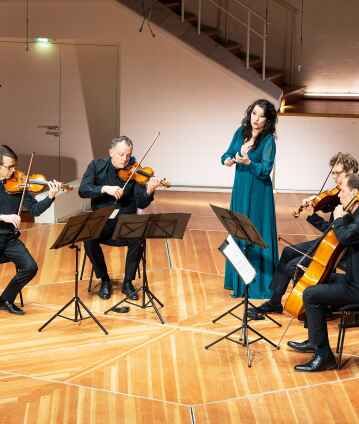
In his expressive Second String Quartet, Arnold Schoenberg addressed a serious marital crisis. A soprano voice with lyrics by Stefan George – performed here by Anna Prohaska – lends the work additional intensity. Schoenberg’s younger colleague Dmitri Shostakovich wrote his harrowing String Quartet No. 8 in response to the bombing of Dresden as a rallying cry against war and fascism. The Varian Fry Quartet opens the concert with a tribute to Bach by Mozart.
When Shostakovich decided to join the Communist Party in 1960, some of his closest friends were appalled. It is likely that he too had reservations about the decision. In any case, the composer acknowledged the autobiographical nature of his Eighth String Quartet, composed that same year. This is easily recognisable in its motivic signature, which is heard right at the beginning and runs through the entire composition: the notes D, E flat, C, B, whose names in German (D-(e)S-C-H) correspond to the composer’s initials. The work consists of five movements that flow into one another without a break. The slow sections are characterised by a plaintive tone, while the fast sections have an unsettling, almost alarming quality.
Arnold Schoenberg’s Second String Quartet is also a work of profound conviction. The words of the folk song quoted in the scherzo, “Oh, du lieber Augustin, alles ist hin” (Oh, dear Augustin, all is lost), can, on the one hand, be interpreted as a reference to the composer’s marital crisis – he had learnt of his wife Mathilde’s affair with his friend Richard Gerstl – and, on the other hand, as a reference to the tonality from which Schoenberg increasingly distances himself as the quartet progresses. In this context, the line from Stefan George’s poem sung by the soprano in the final movement “Entrückung” seems like the heralding of a new kind of music: “Ich fühle Luft von anderem Planeten" (I feel air from another planet). However, the audience of the time was not yet ready for this change of air – the premiere in December 1908 provoked a scandal.
Schoenberg saw Mozart as one of his greatest role models – he once said he had “learned” how to compose string quartets from the First Viennese School composer. As this concert features Mozart’s arrangements of Bach’s works, the programme offers a perspective on music history that spans from the Baroque to the post-World War II modern era.
Varian Fry Quartet
Philipp Bohnen
Christoph von der Nahmer
Martin von der Nahmer
Knut Weber
Anna Prohaska
© 2026 Berlin Phil Media GmbH